

Holy heck! Can I tell you how glad I am to be back writing something fun? What are we bothering with an intro for? You read the title. Let’s get to it!
LAY OF THE LAND
Okay, I guess I should explain the premise a little. As we’ve discussed before, there usually isn’t such a thing as a “perfect game” of anything more complicated than a few keystrokes, as that can imply mistake-free play. But what we are looking for is a theoretical maximum possible score on the “original” Oregon Trail video game – the classic edutainment game that taught us all such valuable lessons as how to waste nearly all our food, that the West was abundant with free land which mysteriously never belonged to anyone before your peaceful arrival, and that the few Native Americans you do encounter all have magic river-crossing powers.
Now, when I refer to this game as the “original” Oregon Trail, I have to put that in quotes, because I’m not talking about the early builds of the game showcased in Minnesota schools, or the primitive version included in “Expeditions” compilations. (Check out this outstanding video by Gaming Historian for the whole story.) We’re talking about the first wide, standalone release on Apple II computers in 1985. You know, the one most of us ’80s kids experienced in magnificent mono-green:

There are a couple later releases on other platforms, like MS DOS, which may be equivalent for what we’re discussing. But I’ll be limiting my analysis to the Apple II version, because that’s what my family had, and to my knowledge most schools relied on that version as well. Now, I would love to do all this using authentic original hardware, but sadly I don’t have access to a functioning Apple IIe, or reasonable means to get screenshots from one. And even if I did, fuck me if our old floppy disks would still work. So… Let’s just tell everyone I used my handy dandy Apple-II-to-Windows-11 ROM archiver, or whatever combination of words it is you’re supposed to say here.

In the game, you play as a family in 1848 who, for some reason, really wants to cross the country to get to Oregon, of all places. Gotta say, as far as premises in video games go, I’ve heard more convincing ones. Maybe for some reason they just really want to attend the Oregon Country Fair? Maybe they heard about the Tetris World Championships, and think they have a shot? (Jokes on them, that moved to Cali.) Or maybe they’ve seen too many episodes of Portlandia? As far as places to migrate to, I guess you could do worse. And to be fair, it could be less about Oregon as a destination and more about getting as far away from Missouri as possible.
You get a few starting options, including party member names, month of departure, and breadwinner’s occupation. If you start as a banker, you get a whopping $1,600 to spend, which I guess was like Jeff Bezos money in 1848 terms. It’s way more than you’ll ever need in the game. It’s more challenging to play as a carpenter, who starts with $800, or a farmer, who gets a meager $400. For my screenshots today, all the full-color ones are from banker runs, and the mono-green ones are from farmer runs. And you won’t see any from carpenter runs, because Fuck Carpenters, that’s why. If you’re a carpenter, and you didn’t literally get rusty-ass railroad spikes driven through your extremities for no reason other than sparing my eternal soul from the anguish of infinite hellfire, then you can piss off. And let’s be honest, even if you do all that, I probably still won’t do a thing you ask.

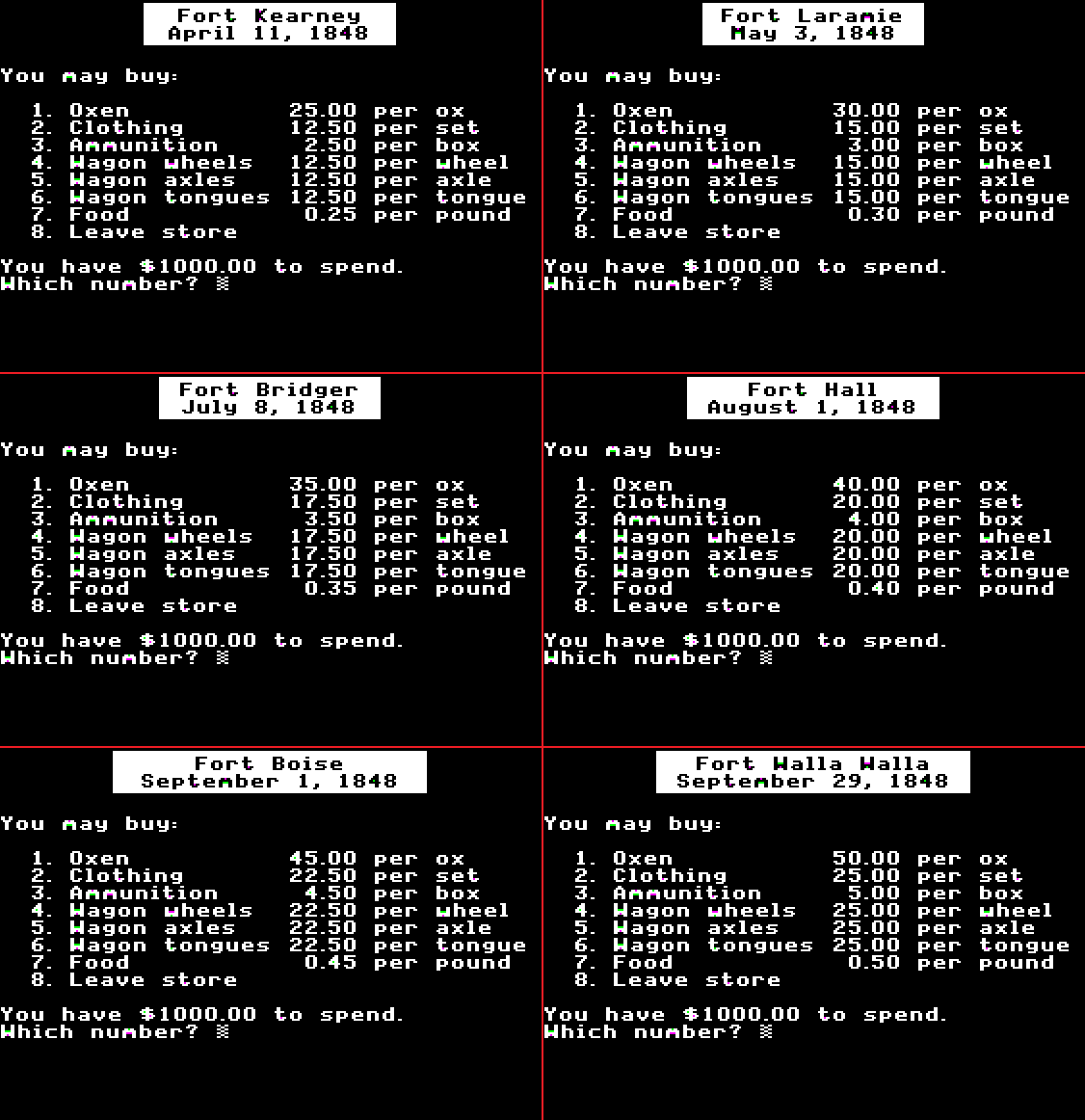
You use all that cash to buy supplies for your trip. This includes food, clothes, oxen, hunting ammo, and spare wagon parts. You can restock at various forts along the way, but prices increase the closer you get to Oregon. You’d also be wise to save some of that moolah to pay for ferries and such to make your journey a bit more reliable.

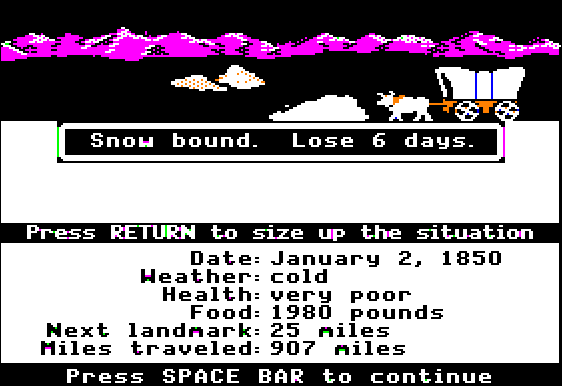
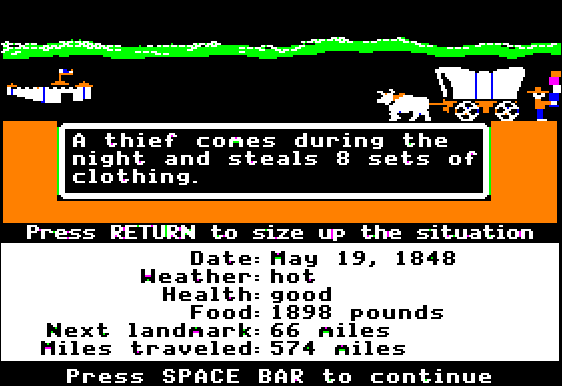
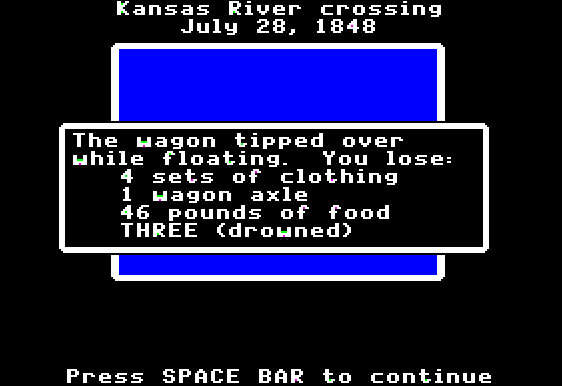
Of course, food gets eaten, oxen die, and wagon parts break down. You’ll encounter all sorts of environmental disasters along the way. Thieves will also jack your shit, and if you’re especially cursed, you can suffer a river calamity or wagon fire that will cost you supplies, or even the lives of your hapless family who trusted you not to do something boneheaded. On the bright side, your food will be supplemented by occasional discoveries of wild fruit, and you will sometimes find abandoned wagons full of cool prizes. (Just don’t ask how these wagons got “abandoned”.)
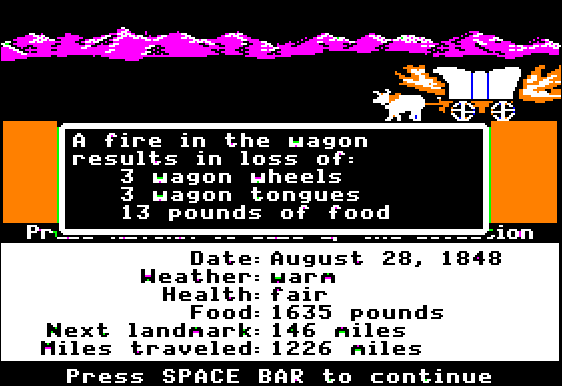
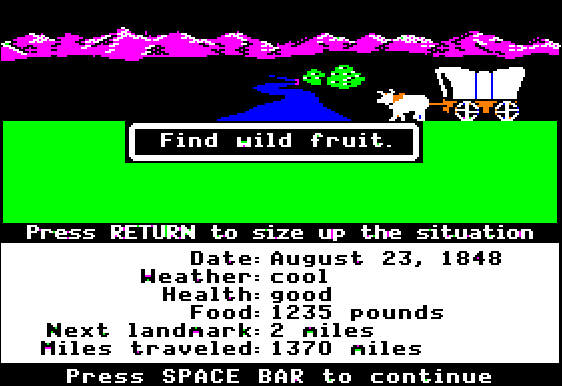
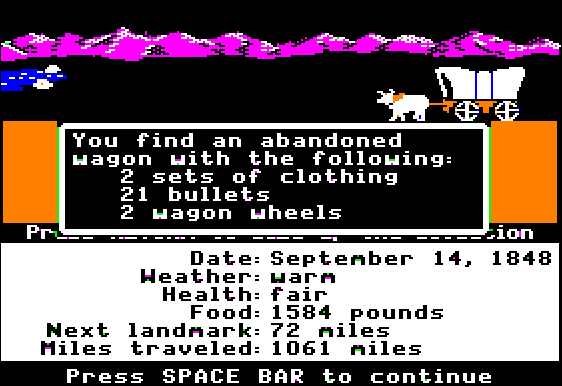
But the best ways to replenish your stockpile are trading and hunting. We’ll be talking a lot about trading a bit later. The hunting side game is pretty fun. When you’re on the trail, you can spend a day out in the woods sniping for deer, or buffaloes, or bears. This all sounds especially perilous, before you even consider the possibility of you and other hunters firing at each other, or your younger family members wandering into the wilderness to play. Hell, I still can’t buy a decent set of lawn darts, and those weren’t nearly as dangerous as 1800s hunting rifles. But in this case, hunting is all safe. Bears will scamper rapidly around the screen at random trajectories, as wild bears are known to do – especially in winter – but they never attack you.

I kid, of course. But the hunting minigame is actually very well-made, and quite skill-intensive. The bits of foliage have wide hitboxes when it comes to blocking your character movement, making navigation difficult, but otherwise these obstacles are very generous. When firing a bullet, the hitbox of any sprite seems to be mapped to the actual literal on-screen graphic itself, which is super-impressive. I can’t even recall another game having that level of collision detail. And there are lots of subtle ways to improve your hunting game. It’s easy to set up in a position with five good lines of fire without noticing that a few steps to your right would open a sixth narrow trajectory, diagonally between two trees. I often find myself moving to a position because I see one direction of fire as viable, without considering that the corridor is too narrow for any big critter I want to spawn there. I’ve also mistakenly stood too close to obstacles, which effectively requires frame-perfect timing along that line of fire. The terrain itself also changes my strategy, as I sometimes decide it’s better to camp in the corner and catch animals rebounding back toward the periphery. And while you’re limited to eight directions, prey moves at more varied angles, sometimes staying within your “blind spot” unless you can pair directional hunting with movement. Oh, and you always have to be mindful of the timer, and when it’s necessary to move toward your target rather than wait and risk running out of time (which I guess would be equivalent to nightfall).
Your food reserves are measured in pounds, which makes sense given the French were still trying to decide how much a kilogram should weigh. No matter how much future-food you shoot in one hunting session, your character is only able to haul 100 pounds back to the wagon each day – assuming your wagon can handle even that much. This always annoyed the normies, who audibly whine whenever a game doesn’t have an easy mode. But I always thought it was good game design. Otherwise, you’d fill your entire wagon in one trip if two buffaloes wandered into your sights. Honestly, the most annoying part of hunting is the random two-pound rabbits and squirrels that somehow get in the way of you shooting giant bison. They are, without a doubt, the “jerk birds” of Oregon Trail.
You’re not allowed to hunt for food at landmarks or in populated areas, I guess because urban violence hadn’t been invented yet. Instead, at those locations, you’re given the option to hear stories from fictional bystanders. Seriously, who the fuck wants to talk to people from 180 years ago? I know you don’t. You don’t even call your grandma! On her birthday! You don’t even know her birthday!

Obviously, there’s an educational element to all of this. Nothing wrong with that. I enjoyed Number Munchers and Spellevator and Carmen Sandiego. As you proceed along the trail, you learn about landmarks and river-navigating procedures and horrifying diseases of the 1800s. You also get treated to charming bits of royalty-free MIDI music unique to each locale. At Chimney Rock, you can jam out to some Auld Lang Syne. At Soda Springs, they’re dancin’ to Charlie Is My Darlin’. I guess Scottish music was all the rage back then. And when your party dies an excruciating death, you’re treated to an adorable MIDI version of Taps.
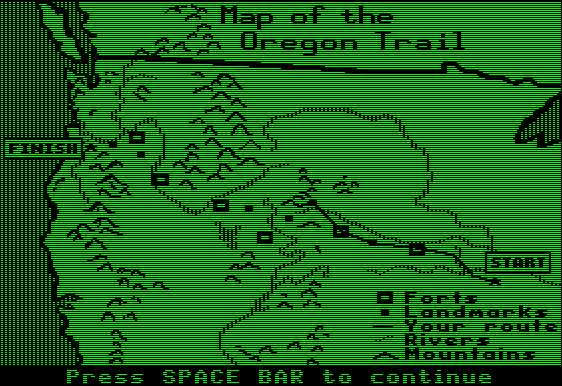

Speaking of excruciating death, the biggest perils in your quest come in the form of rivers. There are three required river crossings, only one of which can be bypassed with a paid ferry. The depths of these rivers changes with the seasons, and even varies day-to-day. If the river’s shallow enough, you can “ford” it, which is another way of saying you just YOLO your wagon right through that shit. That obviously won’t work if the river’s super-deep, but you can instead try and float your wagon across, which sounds like an efficient way to instantly regret your life choices. And if the river’s in-between, you’re just kinda fucked I guess. Hope you brought enough food, cuz you could be waiting there for a while.
Once you cross all these precarious rivers and mountains, you arrive at a place called The Dalles. From there, you have two options to reach the Willamette Valley, and complete your game. The first option is to float your wagon down the Columbia River. As far as game mechanics go, this is a bit less precarious than the earlier river crossings, since you actually get to control your raft, allowing you to manually navigate around randomly spawning rocks. And thankfully, the game will usually not box you in with hazards you have no way of avoiding. If that’s not to your liking, and if you have some cash leftover, you can safely pay your way across the Barl…


More like Barlow TROLL road, amirite?

After reaching the end of the game, in the interest of assessing your performance as a competitive migrant, you are assigned points using what I can only assume is a historically accurate scoring system from the 1840s:

No matter what, you get 50 points for having a wagon. I guess with inflation that would be like a thousand points today? You also get credit for your various supplies you managed to not misplace along the way. You score 4 points for each ox, and 2 points for each spare wagon part or set of clothes. You then get 1 point for each 50 bullets, each 25 pounds of food, and each $5 of cash, with no fractional points for any remainders. As you can see though, the vast majority of your score comes from your surviving party themselves. In good health, each surviving member nets you 500 points, but like antiques at the pawn shop, that figure drops the worse condition they arrive in. In “fair” health, you’re awarded 400 per person, “poor” health gets you 300 per person, and “very poor” companions are worth a measly (and I do mean measly) 200 points each.
If you went as a banker, with all that starting money at your command, your score is your score. However, if you traveled as a carpenter, your final total is doubled, and for farmers, it’s tripled. Obviously, this is a reflection of your choice to play the game on harder difficulty settings. But if you poke around the menus, you’ll find the following justification for why working classes are awarded a higher score:

Hmmm, I don’t suppose they’d find an amateur video game blogger terribly useful. My score would probably get divided by a thousand. “Good afternoon, sir. I see you arrived with a full party in good health, a wagon bursting with spare supplies, and an utterly fucking worthless profession. Here are your two points.”

If your score is high enough, you land on the “Oregon Top Ten”. My fourth grade teacher Mrs. Sweeney assured me that list was fictional, but that’s because she didn’t want me to learn the truth! What they won’t tell you is that the Oregon Top Ten was actually a federal selection program, and that the real Top Ten “pioneers” were chosen to populate the first human colony on Mars in 1874. From there, the descendants of Stephen Meek and Celinda Hines were raised as galactic warriors, and were trained in the use of advanced Andromedaean technology at secret bases on Neptune, Io, and Dysnomia. Decades later, their forces successfully defended the Terran system from interstellar invasion at the Battle of Alpha Centauri, as foretold in the ancient extraterrestrial prophecies, which they also won’t tell you about.

Okay, you get the idea. Now we get to the fun nerdy stuff.
THE MOST IMPORTANT RESOURCE
If you haven’t figured it out yet, Oregon Trail is a resources game. And the game features three key methods of resource conversion. As we’ve discussed, you can buy stuff at forts. You can also hunt for food, which can effectively convert one bullet into 100 pounds of food.
The third method is to trade with other settlers.

This is option 7 from your main menu. You can attempt this at any location, at the cost of one day. (That means your family eats one day’s worth of food – typically 15 pounds – and you end up one day closer to winter.) Using this, you can trade oxen for clothes, or clothes for food, or food for bullets, etc. Trade proposals are conjured by the game, with no option for negotiation. And some days, nobody offers any trades, either because nobody was coming through that day, or because everyone was rightly warned about you.
This is a necessary feature, as your wagon can break down anywhere along the trail – yes, even before you’ve traveled a single mile – or your last ox can die, stranding you far from a fort. So there has to be a way for you to acquire that spare part or whatever you need to resume.
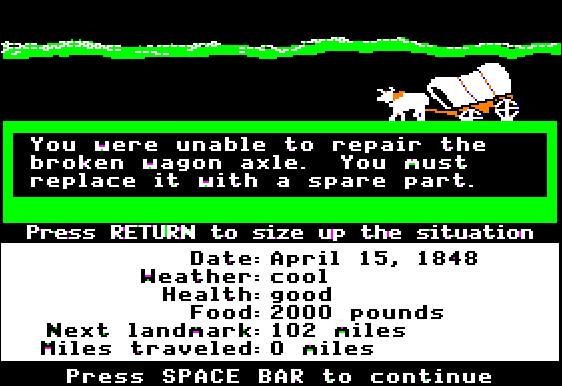
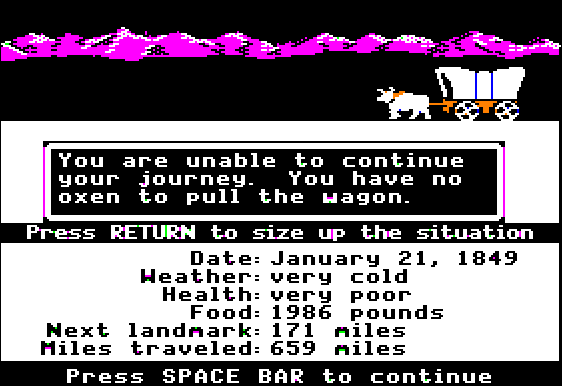
However, for l33t gaming purposes, the trade function is almost always a net negative. It’s necessary. And you will occasionally be offered a trade at even value. But as far as endgame points go, these trades will almost always favor the NPC.
You can try it for a while and see what I mean. Compare the offers you receive to the following equivalency chart:
1 ox
2 sets of clothes
2 wagon parts
200 bullets
100 pounds of food
What makes it a useful way to gain resources (i.e. points) is that it can be paired with hunting. Trading away your bullets for food is super-dumb. Why the fuck would you do that? Why would you tell anyone you did that? But trading away 50 pounds of food for 50 bullets? Genius move! Each and every one of those bullets is potentially worth more than what you traded away, at the cost of only one day of hunting.
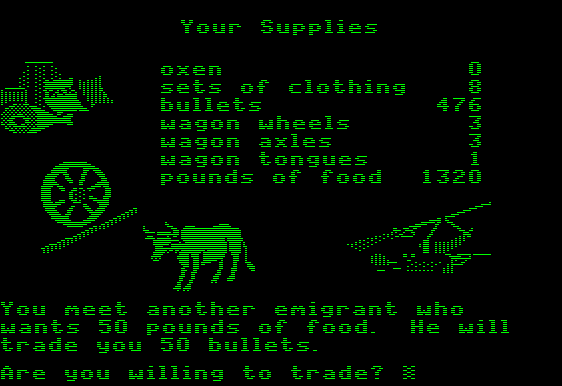
All of this makes food a vital resource. It’s infinitely renewable! Which means, everything else you can trade for is infinitely renewable, too. Trade food for oxen! Trade food for clothes! Trade food for wagon parts! You can rain food around like it’s candy. Even if you’re silly enough to waste your very last bullet, you can still use that food (or your other resources) to trade for more.
Food is also important because, if you run out of it, you die. So, you know, there’s that. It takes like three weeks or so of no food for the game to start killing your people, so I’d imagine it’s a most agonizing death – either that, or your peeps sustain themselves a bit longer trying to eat dirt and rats, which doesn’t sound any more appealing.
So yes, food is very important in Oregon Trail.
But if you’re looking for a perfect score, it is not the most important resource.

You can trade food for bullets. You can trade bullets for wagon wheels. You can trade wagon wheels for wagon tongues, or axles, or clothes, or oxen.
The one thing the game never allows you to trade for is money.

It is the one unrenewable resource. You can spend it, at forts and ferries, but those exchanges only go one direction. At the end of the game, you get points for whatever cash you don’t spend – one point for each five dollars – and there’s no way to get it back.
So the objective of a so-called “perfect game” would be to complete your journey, with maximum resources, while spending as little cash as possible.
TO THE JOURNEY

To illustrate what the start of a “perfect game” might look like, and all the kinds of things that can go wrong, let’s walk through my first attempt at completing the game with only $40 spent. Obviously, we’ll be playing as farmers, because that’s the mode a score-chaser would be playing on. The money penalty doesn’t matter when you’re spending as little of it as possible. I used simple names for people, just for ease of tracking who’s alive and dead. I also chose to start in May, because with no clothes, my family will be out wearing burlap sacks for a while, and I don’t want it to be too cold for them.

Your quest starts at Matt’s General Store in Independence, Missouri. Conveniently, the game forces you to buy a minimum one yoke of oxen from Matt. Otherwise, you’d have no way of leaving town! This is your only forced purchase, totaling $40, leaving you with $360 burning a hole in your pocket all the way to the land of ducks and beavers. Note that one “yoke” is actually two oxen, which means you can trade one while still having the means to leave town to hunt for food.
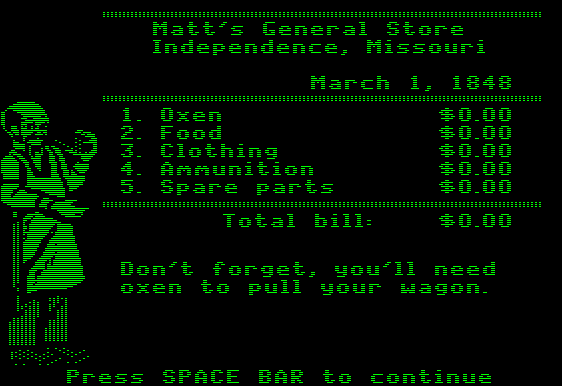
(For those who appreciate minutiae, once you leave Matt’s, you can choose option 9 to buy more stuff. And that store, which offers the same prices as Matt’s, does allow you to buy an individual ox at a time, if for some reason it was crucial for you to have an odd number.)
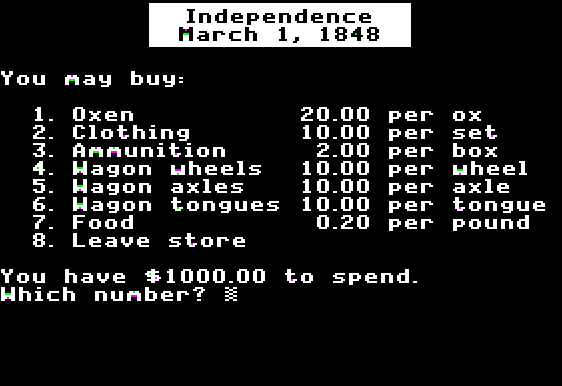
At that point, it’s time get on the trade grind! #hustle #mindset Remember, your family’s eating armadillo turds each day you fail to secure proper food. It’s not really food you need, as much as bullets to produce food. But either way, you’re at the whim of the game, and you need to make some lucky conversions quick.

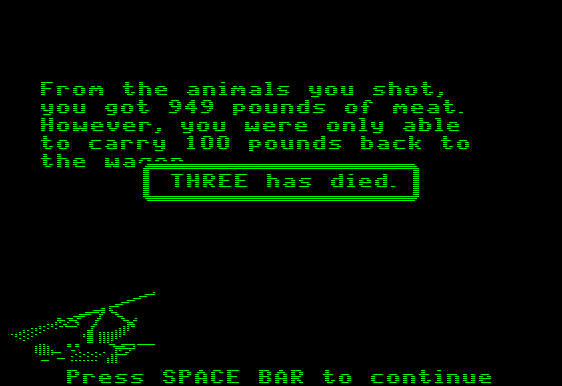
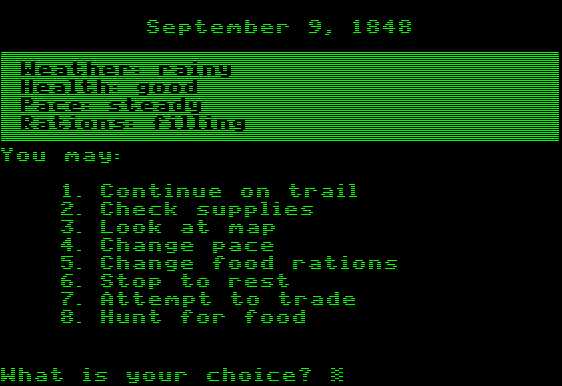
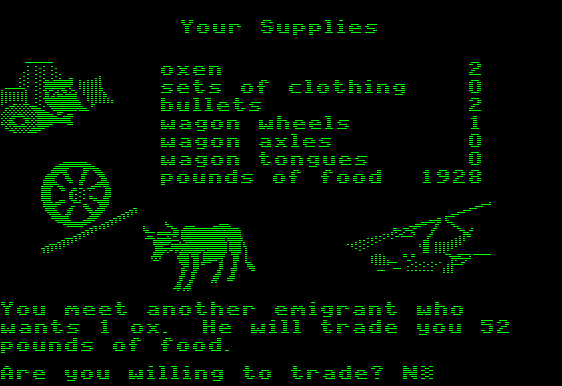
I was fortunate to land upon the necessary trade proposal – one ox for bullets – on my first go. It was day 27, with no food, heralding what would be a difficult slog to recovery. Three of my crew had died, and as you see here, another was dying as I consummated the trade:

That’s okay, I thought. This is just a proof of concept run. I just wanted to show how to get to Oregon with a farmer having only spent $40. My next member died as I was hunting for food, but like Bonnie Tyler, I began to turn around. My “very poor” health improved. I traded away my last ox for clothes (which I then flipped for more bullets, lol) forcing me to camp out near Independence a while longer. By September I had stabilized, but I knew I’d have to wait out the winter before I was ready to proceed in March. (And yes, the game properly tracks seasons across multiple years.)
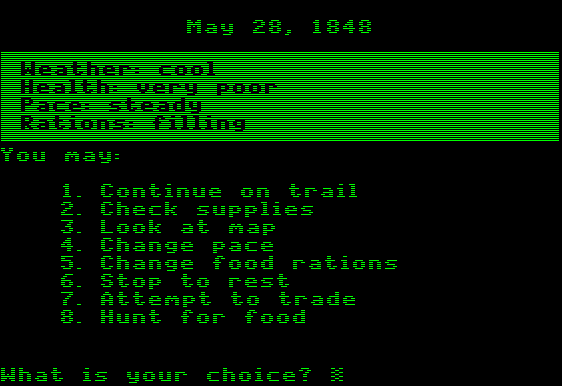
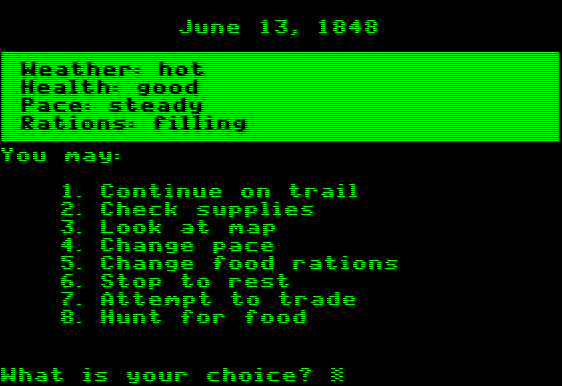
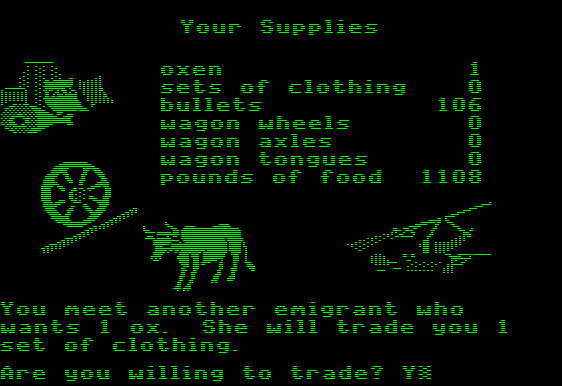
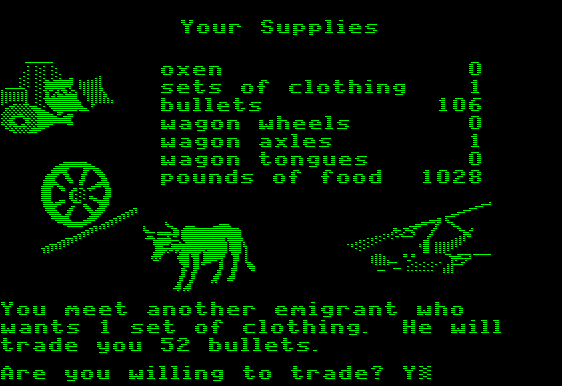
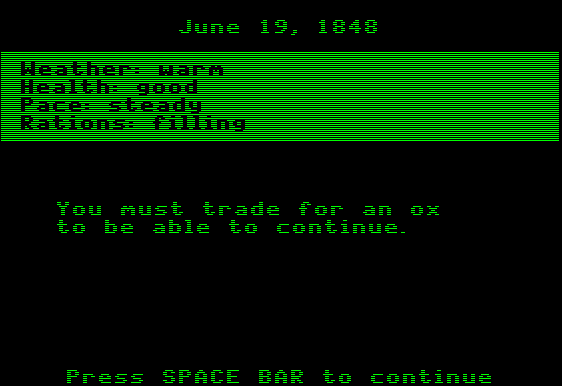
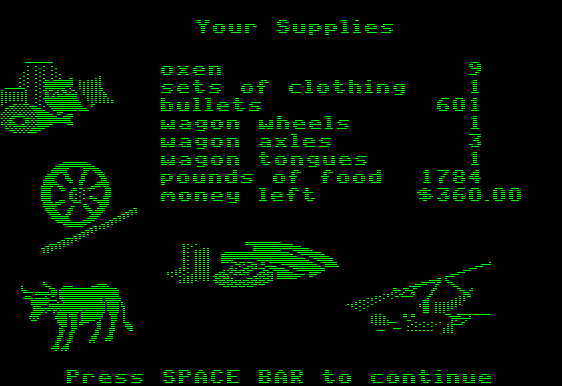

It turns out, crossing the first river in March is a shit proposition, so right away I was forced to wait about a month for better conditions. Hey, at least with family dead, I was only eating 3 pounds of food a day. You can safely ford the river at a depth of 2 feet, but I didn’t know that yet and was being cautious. All I cared about was seeing that beautiful riverbank appear on the far end.
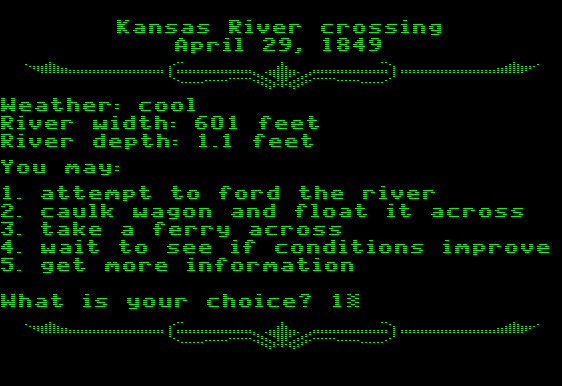

The second river was easy peasy, giving me a long stretch of relatively safe traveling. I had become an ox collector, thinking maybe having a fleet of oxen would make me travel faster. (It doesn’t seem to.) I flipped over to disk side 2 at Fort Laramie, as is tradition. At South Pass, I chose the longer Fort Bridger route, as that would mean one less river to cross.
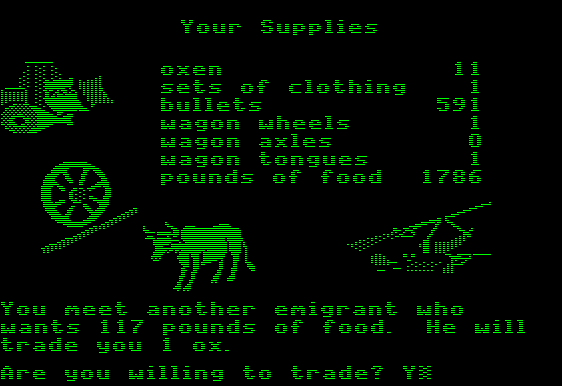

As I approached the fort, disaster struck! A fire had destroyed nearly all my food, not to mention the only clothes I had off my very back. I wasn’t back to square one, because I still had my army of oxen, but that was about all I had. At this point I was a game-year into this quest. I was committed. This felt like one of those legendary runs, not because you’re doing exceptionally well, but because you’re trying something new, and it’s your first viable stab at that goal. You’re persevering through the struggle, and you’re determined to see it through. I was dedicated to winning this, however long it took. I would rebuild.
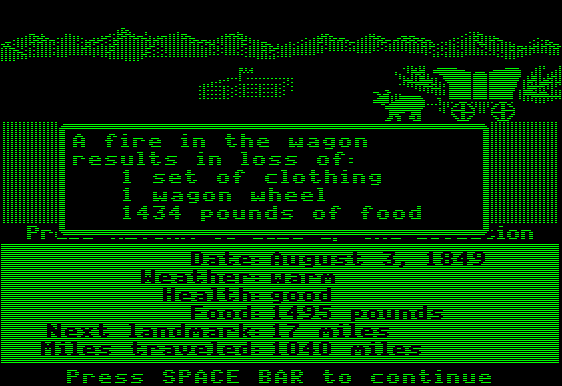
But then, three hours into this game, I faced the worst calamity of all…

My finger slipped!! I don’t know what key I hit exactly, escape or tilde something. I tried and tried to get back into my game, but to no avail. Flipping back over to disk side 1 brought up the title screen. I was crestfallen, and not just because I had reset three hours of work. You’re a gamer, you know how it feels. I was so intent on beating the odds and seeing that struggle through to completion. It was one of those magic one-time-only runs you can never get back.
I could’ve cut this story for length, but the reason I didn’t was to make a point: In addition to in-game requirements, you can’t forget that a perfect score on Oregon Trail also carries real world considerations as well. Power outages, Windows updates, etc. Even a bad keystroke can end your run! And this game offers no save files or passwords to bail you out. Let’s just say, I was much more careful where my fingers landed after that particular boondoggle.
Obviously I got back on the figurative horse, even if my follow-up run would never feel the same. I decided to leave in July, for even more favorable burlap weather. I also realized that accepting your first ox trade for any item would enable more possible trades for bullets, since you would have two different kinds of resources to trade away. (Just don’t forget to leave town before you trade your last ox, or else you won’t be able to hunt for food.) I learned that, despite my initial luck, a few party wipes should be expected, as you may never see the ammunition trade you’re looking for. But after a couple more resets, this strategy paid off, as I exchanged a wagon axle for 47 bullets.

Once you’ve got some bread in your companions’ faces, you can start diversifying your portfolio. Trade out those strategically placed leaves for some proper clothes. Collect some spare parts, which will get you more spare parts. Find your ox some oxey friends. And of course, bullets bullets bullets, and food food food.
I restocked my food by September, with 2 bullets to spare. By spring of 1849, I was fully decked out. My oxen accumulation habits returned, prompting a wait through yet another winter. I lost a third party member in April 1850, but I pressed on, arriving at The Dalles in July. I rested my way back into good health, which you should always do when playing for points. And being the spendthrift I am, I floated down the river for a free ride to Willamette.
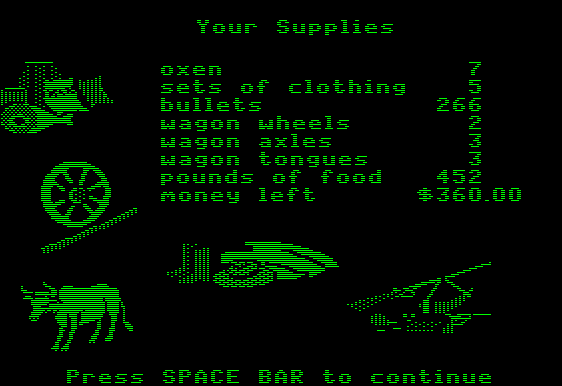
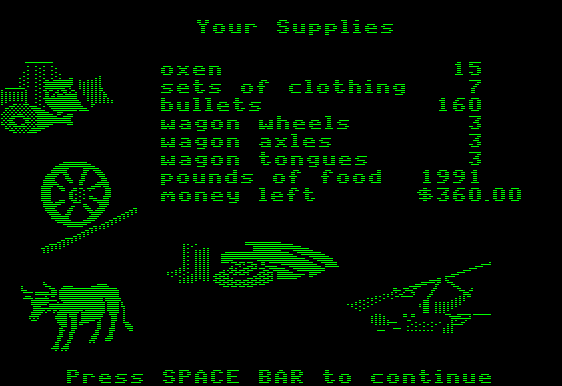
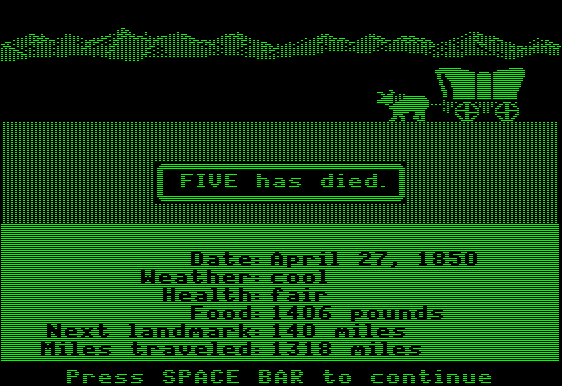
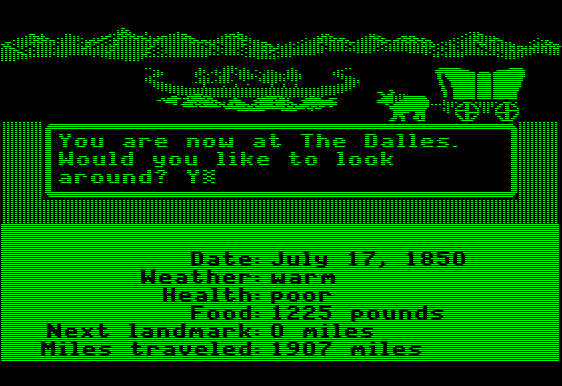
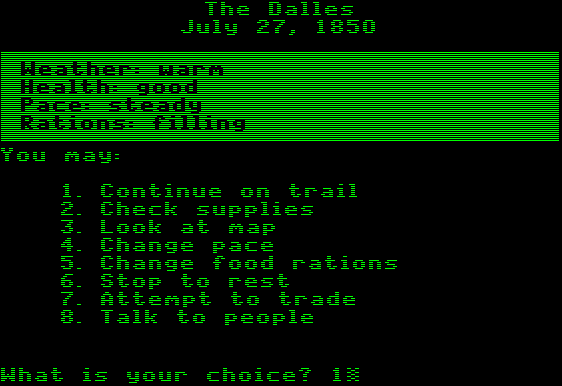

I only had two people, and way more supplies and oxen than they’d ever need. But I proved I could reach Oregon with a farmer on only $40.

So for a perfect score, you just have to do all that, without the sucking parts.
Okay, it’s a bit more complicated than that. But that’s where you continue reading.
FATHER KNOWS BEST
With the basic premise established – that it is possible to jump through extra hoops to complete Oregon Trail spending only $40 – it was time to start stress-testing various boundaries the game had to offer. Among other things, this involved a bunch of practice runs aimed strictly at accumulating as much of a given resource as possible.
The problem I soon faced was, your family just eats way too much food, too quickly. I get it, that is both real life and the intended operation of the game. But when you’re trying to stockpile enough ammunition to overthrow Texas, it’s counter-productive to waste a bunch of time hunting, to feed people you never had any intention of delivering to Oregon alive. Oh, and you’re also expending the very bullets you’re trying to accumulate. You can lower food rations, but your health will deteriorate, putting you at risk of a premature restart, and that still only slows the problem anyway.
If you’re going to research the minutiae of this game, what you really need is to dispose of all these worthless hangers-on, which the game requires you to bring along. That way, you’re just one person, eating one person’s worth of food each day. And the game only allows one method for doing this, which after several of these runs, I became quite adept at.
And so, for the benefit of anyone else interested in testing aspects of this game, I present to you…
THE OFFICIAL ersatz_cats GUIDE TO KILLING YOUR FAMILY
(on Oregon Trail)
Step 1: Buy all the supplies you want at Matt’s store, except no food.
You’re gonna want stuff for your journey, right? Maybe you want full supplies to actually reach Willamette alone. Maybe you’re up to something wacky, and you just want a bunch of wagon wheels. Just remember, no food. You already know why.

Step 2: Choose option 6 – “Stop to rest” – and choose the maximum 9 days. Do this twice more for a total of 27 days rested.
Somehow, your family will survive almost that long without sustenance, and will only start perishing during that final stretch. You may have to resort to Step 3 to unalive your fourth and final companion. This is why convenient name tags are important. They keep all your victims accounted for.
Step 3: If any companions are still alive after 27 days, rest a day or two more to correct that oversight.
Sadly, there isn’t a screen you can view to confirm how many surviving members your party has, so it would be good to track each death as it happens. (If you have a food supply, you can check how much is eaten in one day, but obviously that doesn’t apply here.) Note that your party leader will never die or suffer any maladies until all four of the others have expired. So if their name comes on screen for any reason, you know you’ve rested long enough.
Step 4: Choose option 9 and buy 2000 pounds of food.
Conveniently, while you’re still at Independence, option 9 offers the same prices as Matt’s. It’s like you haven’t gone anywhere!
Step 5: Choose option 6, and rest for two spans of 9 days.
A hearty meal will bring the color back in your cheeks and the pep back in your step, as will the knowledge that your loved ones are no longer suffering.
Step 6: Return to option 9, and buy exactly 54 pounds of food.
This will restore you to a full 2000 units of food again. Sadly, the game doesn’t allow you to go full Alfred Packer and add your family to your food supply.
Morbid? Yes. Efficient? Also yes. Easy? Totally. But remember, this is the 1800s, so as long as you never speak of this to anyone, you can just remarry and start a new family somewhere else. And it’s not like your once-playful and innocent children wouldn’t be proud of their papa. After all, they were sacrificed for science!

THE OUTER LIMITS
Okay, with that out of the way, let’s get back to the fun nerdy stuff. We’ve established that $360 is the most leftover cash you can complete the game with using a farmer. At a rate of one point per five bucks, that nets you 72 points, which is tripled to 216.
But what are the maximums of your other items?
No matter how many abandoned wagons you find, or how many spare oxen you have to pull them alongside your own, it seems you can only ever bring a single 50-point wagon to Willamette. So I guess that item’s set in stone.
As described earlier, your score is scaled based on the health of your party. So for the best score, you have to do whatever it takes to bring your spouse and all three crotch goblins to the Beaver State alive, and to get them all in tip top shape just long enough to stamp your score. Note that eschewing the Barlow road and floating down the river is ideal for this. If you were to take the Barlow toll road (which costs a variable amount), there’s a bonus stretch to travel. Your wagon will approach Willamette just like any other locale, at which point your game immediately ends. But as with any location in your journey, it’s possible for your health to randomly dip at the exact moment you arrive. And then you can’t do anything about it! You came all that way, and got penalized because your little brat caught dumbass cholera or whatever on the very last day. But if you wait at the Dalles, as long as you say “Yes” you want to look around, you can rest however many days you want prior to proceeding. And whatever health your party is at when you choose to float down the Columbia River is locked in.
So even with no other resources, that’s 2500 points for five people in good health, 50 points for the wagon, and 72 points for the cash, which is tripled for a base score of 7866. That alone puts you atop the in-game leaderboard, so everything else you accumulate on top of that is gravy.

Playing with banker cash, it doesn’t take long to discover you’re limited to 20 oxen. I was kind of sad, as I was hoping to have hundreds of oxen, all marching abreast. A full bovine legion spanning the entire width of the Great Prairie, like I was the Oldsmobile patriarch born 50 years too early for the automobile. Similarly, each spare wagon part is capped at three. Believe me, I tried to be clever, seeing if I could buy two and then another two to bypass this limit, but no luck.
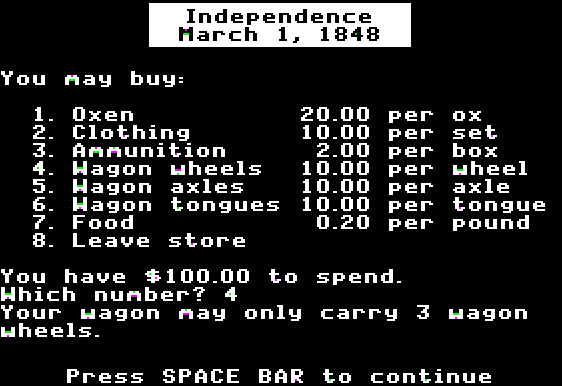

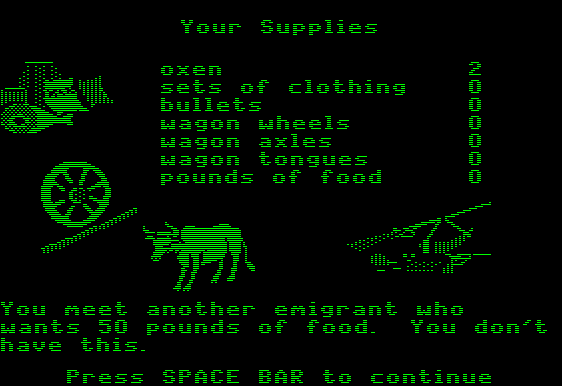
Once you start exploring these maximums, you notice some odd idiosyncrasies with the trading system. The most obvious is when folks ask for four of a given wagon part, which you literally cannot have. My guess is, the algorithm was programmed to randomly place an offer within a range, stretching from an even value trade (two parts for one ox) to half value (four parts for one ox) or worse. And this algorithm wasn’t instructed to take into account whether the request was possible. That said, the program was robust in one other way. You are never offered a trade which would exceed your maximum capacity. If you have three spare wagon wheels, nobody offers to provide you with a fourth. You often receive requests for items you don’t have, but the trades you are mechanically forbidden from accepting do not appear. My guess is, when the game internally rolls such trade offers, they’re negated before appearing on screen. Instead, you get the “No one wants to trade with you today” message, which you seem to receive much more frequently when multiple of your items are maxed out.
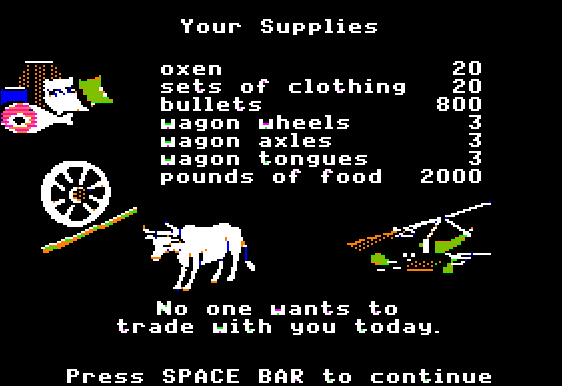
Anyway, 20 oxen nets you 80 more points. 9 total spare parts are also good for 18 points. Note that while you can accumulate up to 2000 pounds of food, because of the way the game processes each day, you will eat some of your accumulated food after the day’s events. To put it another way, you can hunt yourself up to 2000 pounds of food, but as soon as you do so your family has already eaten their daily allowance, leaving you at 1985. That number assumes full rations, but either way, this will dip you below 2000 pounds before you can arrive at Willamette the following day. You get one point for each 25 pounds of food, so if you can finish with at least 1975 pounds, that’ll get you 79 points. Add all that, and triple it for being a farmer, and you’ve bumped your score up to 8397. And that’s before adding any clothes or ammunition!

I tried pressing my luck with the accumulation of clothes. I bought 99 sets from Matt’s, then immediately turned around (using option 9) and spent the rest of my non-oxen money on 57 more. I spent a few hours (sans family) hunting for food and accepting literally every trade for more clothes I could get, just to see if the game ever stops me.
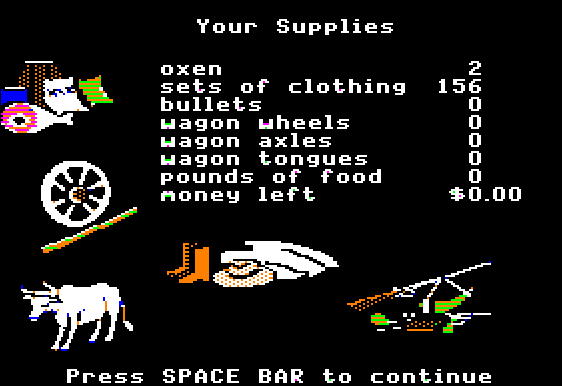

I wondered if maybe the clothes counter would stop at the magic number 255 (2 to the power of 8, inclusive of 0). For those who don’t understand what I mean, that’s the largest variable that can be tracked by a single byte of data. Some older games are told not to increment such variables any further, while others lack such instruction and roll back over to zero. In this case, once I surpassed that number, I knew this variable was using more than a single byte, and that the number would keep on going. I pushed past 300 anyway, just to see it happen. I have no idea what the actual limit would be; you would need a code analyst for that. But I do know you get 2 points for each set of clothes, so I would’ve netted 636 points for my mobile Nordstrom store I had accumulated, which for a farmer would’ve been tripled to a whopping 1908 points.
This left the question of how many bullets a player can accumulate. In Missouri, ammo is sold at a rate of $2 per box, with each box containing 20 bullets. Curiously, I noticed the store only allows you to purchase three digits worth of ammo boxes, whereas food allows four digit purchases. I’m not sure if that’s relevant. Regardless, aside from the $40 you have to spend on oxen, I plugged every last dollar I had into ammunition. And I ended up with… 5600 bullets?
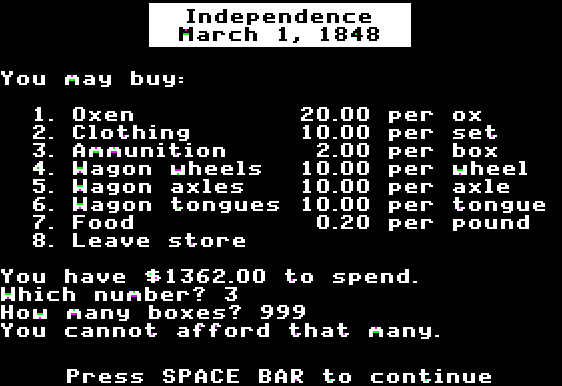
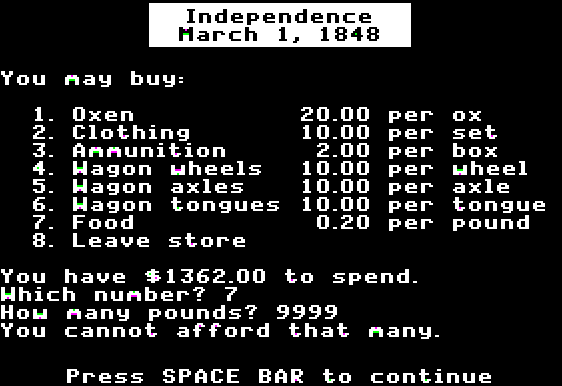
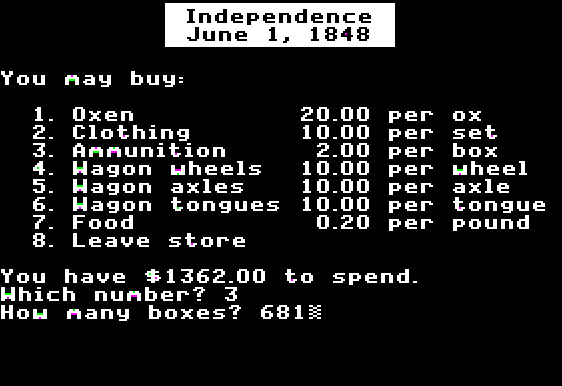

Well, gosh darn it, that doesn’t make sense. That’s not one of those magic 8-bit numbers, like 255 or 65535. Is that really the maximum number of bullets you can have? Or is it just the maximum displayed? I went out and fired exactly one bullet to prove it’s not a matter of the game tracking more while displaying less. So where exactly did all that money I spend go? Was that crooked shopkeeper just taking my money and giving me nothing?
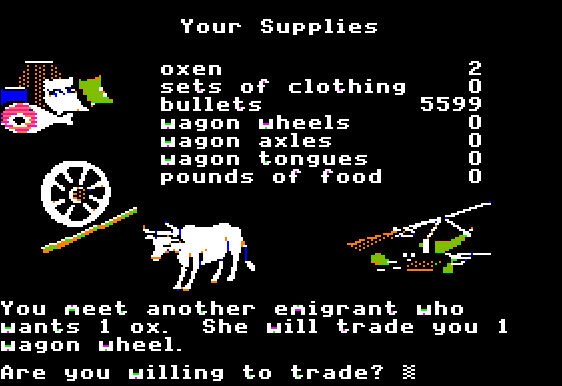
I restarted, and focused again on ammunition, but this time spent my money more slowly. I crept up to all 9s, and spent beyond it. And that’s when I figured out what happened.

Ohohohoho. That wasn’t 5600 bullets. That was 15,600 bullets. The game just dropped the leading digit, Pac-Man style. But it still tracks it! If you hunt down below 10,000, your odometer will roll back to 9998. I double-checked the math, and it all made sense. If you could spend all $1600 banker bucks on ammo, you’d have 16,000 bullets, but the $40 you spent on a yoke of oxen subtracts 400 bullets (20 boxes) from that total.
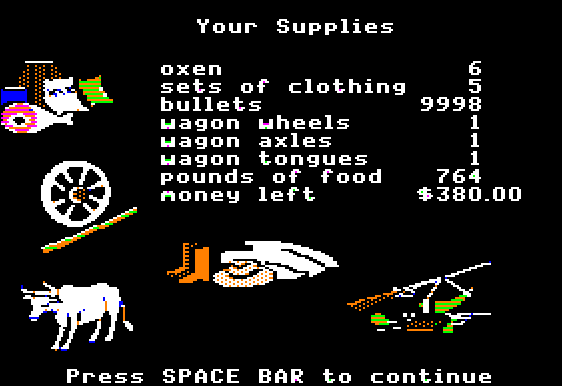
Obviously, the next mission was to see how the endgame treats this potential variable overflow when calculating your score. (I guess in retrospect it would’ve been valuable to confirm the game handles 300 sets of clothes as expected, but I don’t really see why it wouldn’t.) In my first attempt, my wagon drowned, losing over 2000 bullets. Next time, I succumbed to a wagon fire destroying ten thousand bullets.
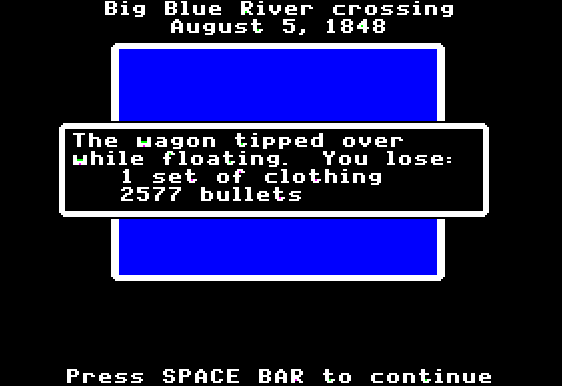

The five-digit display worked fine that time, lol. Obviously I persisted, and on my third attempt, I arrived at Oregon, with my ammunition accumulation displaying off the screen.

Yeah, that number is supposed to be 11,822. But as you can see, the game tracked it just fine. You’re awarded one point for every 50 bullets you end the game with. And thus, for having over 11,800 bullets, I was given 236 points.
Thus, without knowing the maximum totals for either clothes or ammunition, we could say a perfect score on Oregon Trail is as follows:
8397 + B + C, where B = ([Maximum Bullets] / 50, no remainders) * 3, and where C = [Maximum Clothes] * 6.
Using the highest totals I was able to accumulate, of 318 clothes and 15,916 bullets, that would place our highest demonstrable score at 11,259. Though it’s safe to assume the game will go plenty higher than that.
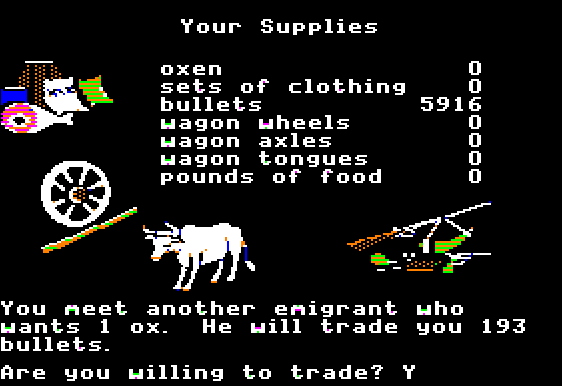
Obviously, there exists some presently unknown material maximum to both variables. These games assign internal memory values, which will eventually reach capacity. There’s also some worry over the fact the game wasn’t programmed to properly display supply variables over four digits. Let’s say, hypothetically, your ammunition maximum is 65,535. (That was a standard variable cap back in the day, as it’s the highest number that can be represented by two bytes, if zero is included.) The game checks to prohibit you from underflowing that variable – i.e., you can’t spend or lose bullets when you have zero. But it may not check for an overflow. It could be that you could accumulate 65,500 bullets, trade for 100 more, and suddenly find yourself with a grand total of 64 bullets. (To say nothing of how the rolled over digit could affect some arbitrary variable stored in an adjacent address. It would suck if that happened to be something important like the “Character 5 is not dead” value.) So there could be a situation where, once code analysis determines the hard cap, you have to find a way to acquire exactly that amount of supplies, and not one increment more. That’s not really an issue for clothes, which are typically acquired one set at a time – although heaven forbid you unwittingly find an abandoned wagon with five sets of clothes which instantly antimatter your existing wardrobe into oblivion. But bullets are never acquired in single increments, not in shops or in trades. When you’re parked right before the Dalles, trying to sculpt your ultimate perfect score, you could possibly be forced to cycle through trades hoping for the exact number you need – and you’re eating down your food supply as you do that.
Oh, and all of this assumes the endgame scoring function handles these excessive values properly. It could be that you could acquire however many sets clothes, but your clothes score can only reach 65,534 before overflowing, meaning it would be disadvantageous to acquire more than 32,767 sets of clothes even if the game permits you to carry more. Finishing the game with 32,770 outfits may net you a whopping six points.
At any rate, if one was determined to achieve this mythical perfect score of Oregon Trail, here’s what you’d have to do. Play as a farmer, probably start during a warm month, buy a single yoke of oxen, and trade one ox for bullets (or for another thing which is traded for bullets). Park near the beginning, and hunt for food. From there, trade the food you acquire for all your other necessities, until you’ve accumulated a reasonable supply for your journey to Oregon. From there, travel the trail, keeping all your peeps alive, and spending no money on ferries or anything else.
Once you’re within one day’s travel of The Dalles, immediately hit Enter to go to the menu. You’ll be here for quite a while, as in like a few hundred in-game years. Start hunting for food, and grinding trades. Your focus should always be on acquiring more clothes and ammunition. Don’t be afraid to trade at a loss for those items – that’s how I got my clothes numbers as high as I did. You can always get back up to three of each wagon part and twenty oxen. And food is limitless by way of hunting. You want clothes, clothes, clothes, and bullets, bullets, bullets. Basically, you’re part Ted Nugent, and part Lady Gaga. Thankfully, it doesn’t seem your party members will die outside The Dalles, not even in winter, and you won’t encounter thieves or wagon fires while in your menu standstill.
If the true maximum of bullets is not divisible by 50, then your path is clear. You have however many spare bullets to maximize your food supply, before any further hunting would reduce your ammunition score. When you’re about to max out your food, you have to change your rations to “meager”. Remember, food is scored in increments of 25 pounds. Five people eating for two days at “filling” rations will drop you to 1970 pounds of food, costing you a point. Do your final hunt up to 2000 pounds. The day tolls, and under “meager” that number drops to 1990. Proceed to the Dalles. The number will drop to 1980, which will still net you 79 points. And motherfucking pray that after all these countless hours of work your party’s health doesn’t randomly drop to “fair” due to the weather or lighter rations. Immediately get on the Columbia River, and pray again that the river rocks don’t block you out from reaching the final trail.
If the true maximum of bullets is divisible by 50… all of this would still seem to apply. You’ll just be out one ammunition point when you necessarily bring your food up to 2000, which will also drop one point as your party eats food. If it were possible to trade, say, five pounds of food for a single bullet, you would be obliged to do so for a perfect score. And the process for maximizing your bullets while staying within 25 pounds of max food would be complicated. But I’ve never seen the game offer a food trade that miniscule. So thankfully, that’s not an actual scenario to contend with. However, if the true maximum of bullets was slightly above a number divisible by 50, you could indeed have a very narrow margin for maximizing your score from both ammunition and food.
Again, it all depends on how the caps on these variables are handled. Since bullets offer a fractional score (one point for every 50 bullets), let’s assume they top out at 65,535. This would yield 1310 points, in addition to our previously established 8397. Barring some overflow wackiness, your clothes score should be an even number, since you get two points for each set. If that score itself tops out at 65,534 before rolling over, then a theoretical perfect score on Oregon Trail would be 75,241. However, if the game instead handles your clothes quantity up to 65,535, with no limit on the associated score, then a perfect score would be 140,777.
Okay, I think I’ve considered all the variables here. (Har har.)
FROOT LOOPS
So that’s it, right? We’ve cracked the code, more or less. I mean, we didn’t literally crack the code. We would need someone who could analyze Apple II programming to tell us what the true maximum of bullets and clothes are. But plus or minus a few fictional loved ones, we have a satisfactory answer of what it would take to achieve a perfect score on Oregon Trail.
And all was happily ever after.

Uhhhhhhhhhh………
Wait…..
What?
Hey Babs, how many pounds of food have you got there in that wagon?

Okay. So allow me to explain.

As mentioned previously, you will sometimes find wild fruit along the trail. Every time you get this encounter, it will supplement your food supply by 20 pounds. Normally there’s nothing strange about this, because you’re rarely within 20 pounds of your intended maximum. But if you’re trying to break the game, you might do something silly like Menendez all your family, set rations to “bare bones” so you’re only eating one pound of food a day, and try over and over to break the fruit barrier. The way I arrived at exactly 2020 pounds of food was, I bought up to 2000 pounds at Fort Kearney, and then found wild fruit before even progressing an inch toward Chimney Rock.
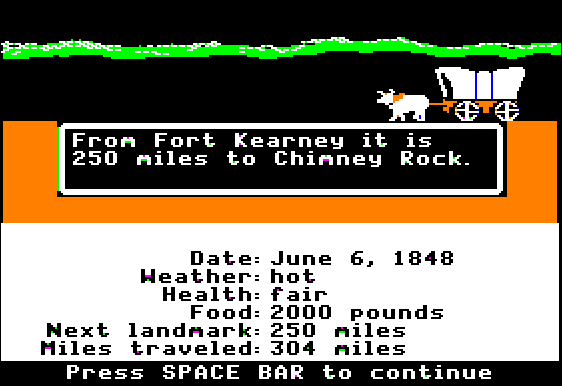
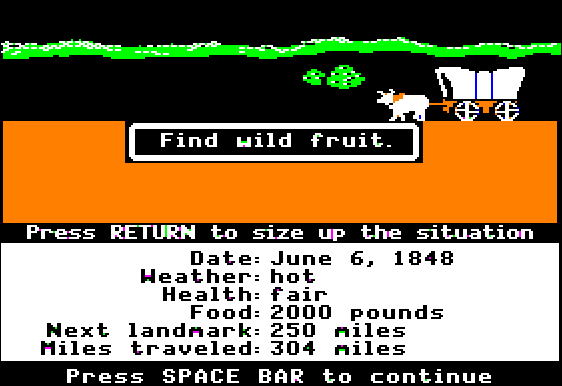

Before I continue, I should note there is an alternative free lunch event, labeled simply “Indians help find food” with no graphical depiction. This event actually offers thirty pounds of food, and seems much rarer than “wild fruit”… until you figure out what’s going on. It turns out, this event actually occurs only when you’re dangerously low on provisions; I was only ever able to encounter it when at strictly zero pounds of food. However, under those conditions, it happens as frequently as anything else. I didn’t notice it for the longest time because this is a field event, and all my family science experiments were done at a standstill in the menu. I do like the flavor touch of this, though. Sympathetic Native Americans have been saving dumbass white settlers from consequence-induced starvation since 1492. Anyway, getting back to today’s premise, since this only happens at low food levels, and we’re trying to break the game with maximum quantities, this particular event doesn’t help as much.
It does seem these free food sequences aren’t programmed well in general. The “wild fruit” event happens kind of in between days, so your daily consumption occurs before the 20 pounds is added to your inventory. If you immediately go to your menu and check supplies (option 2), the game will show an incorrect number – sometimes higher, sometimes lower. If you then return to field view, or hunt, or use option 6 to rest, the variable will correct itself, and your total will be what it should be (accounting for daily food consumption). But if you choose option 7 to check for trade offers, even if no trade is made, and then on the following day you use option 2 to check supplies, the incorrect number will become permanent (again, minus the daily consumption that occurred in the meantime). Next time you play the game, try this for yourself. It works any time you find wild fruit, no matter what your food total is at. This is actually an easy manipulation you can do to score extra food, if you prefer the incorrectly displayed number. And yes, the “Indians help” bonus also seems similarly phantasmal when checked in the menu. No matter how well some games are made, there’s always some duct tape somewhere behind the scenes.

But yes, the wild fruit algorithm does not check to see if adding 20 pounds to your food total will exceed the intended maximum. Aside from that and the display bug, everything else seems to work okay. If you go hunting while at maximum food – something you’re not normally allowed to do – you get a unique “your wagon is full” message (different from the more typical your wagon will only hold another [X] pounds” message). After a few attempts, I was able to find fruit 60 miles from The Dalles, and was able to switch to a grueling pace, preserving 2011 pounds of food for my final total:
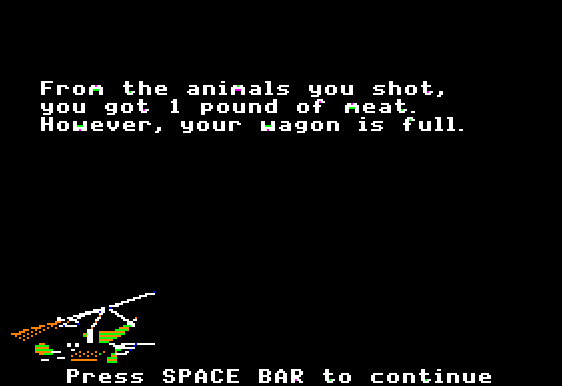
![your wagon will only hold another [X] pounds”](https://perfectpacman.com/wp-content/uploads/2025/08/Oregon-Run-A-25.png)
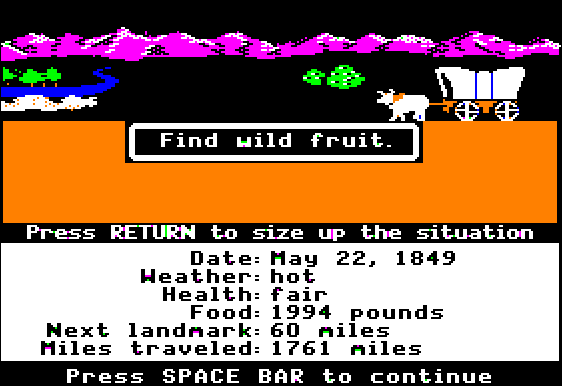

And as you see, I was awarded the full 80 points for having at least 2000 pounds of food. Remember, the rate is 1 point for every 25 pounds. So having above the intended maximum didn’t make the game glitch out.
And you know what this means. Yes, on top of everything else you have to do to secure a perfect score on Oregon Trail, you would also have to bump your food total to 2000 or more, to claim that final, perfect point. That complicated scenario I described a moment ago? The one I said needed to be conducted within a single step of The Dalles? You would actually have to go to all that trouble as soon as you’re within a day’s range of The Dalles on grueling pace – because remember, you can travel at different speeds.

So you fill your inventory to capacity, you get your bullets to near-maximum, and hunt yourself full on food. Oh, and don’t forget to set your rations to “bare bones” before your last hunt, since you don’t want your dumb family to be eating away all your precious points. Then, instead of finishing the game, you take a roll on one day’s travel at steady pace – the standard setting, which is the slowest you can go. And you hope for that magic bit of wild fruit. And if you get your lucky RNG, you immediately change pace to grueling, and haul ass to The Dalles while your food is still north of 2000 pounds. And again, you hope your health doesn’t drop. And, since this process involves field movement, you’ve now introduced all those other variables, like potential wagon fires, and thieves coveting your rickety wagon stuffed with treasure.
If you don’t secure that bonus wild fruit, that’s what that extra distance from The Dalles was for. Immediately enter the menu again, reset your rations, get yourself back up to near-maximum bullets, return to “bare bones”, max out your food again, and give it another roll. Sure, it took countless hours of your precious, dwindling life to accumulate a full inventory for a near-perfect score, but hey, you’ve got like two or three chances to get the lucky RNG that’s also required for true perfection.
Oh, but you knew this wasn’t gonna be that easy…

Yes, after several practice runs, while staying as close to 2000 pounds of food as I could, I was once able to find wild fruit on one day, and then find another batch of fruit the very next day, boosting my total all the way up to 2035 pounds. I wasn’t able to get this to happen in the span preceding The Dalles, only because endgame study is a little more complicated than early game research, where you can reset at will. But let’s be honest, this is almost surely possible anywhere wild fruit can be found. And should you arrive at Willamette with 2025 pounds of food or more, the game will probably calculate your final food total in excess of 80 points.
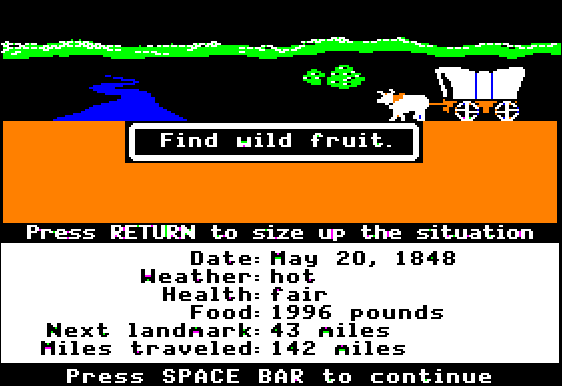
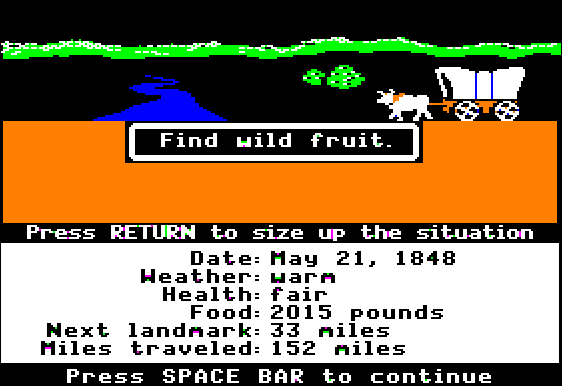
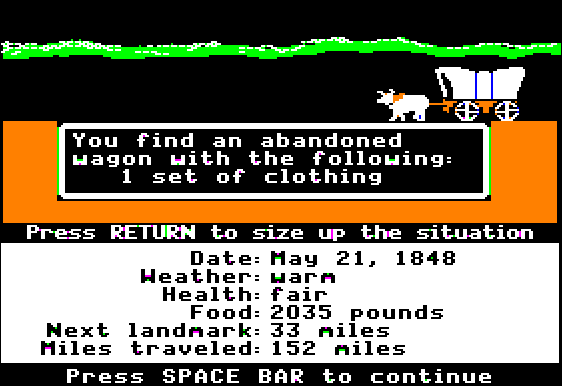
And sadly, much like the wagon itself, that’s where the dream of a perfect score on Oregon Trail breaks down. Your party, moving as slowly as 20 oxen would allow, would have to chance upon wild fruit one step prior to The Dalles… and the step before that… and the step before that. Literally, every step along your journey would have to involve discovering more fruit than any wagon could reasonably handle. You’d be staring over the horizon of a wild fruit singularity, with berries and grapes and apples as far as the eye could see.

Again, the “Indians help find food” event doesn’t apply, as that only occurs when you’re low on food. But you would have to land wild fruit luck at every single location, including at the moment you’re leaving any landmark, as I did above at Fort Kearney. Note that video game RNG does run on seeds (pun always intended), so it may not even be possible to roll fruit at every point, but in that event you’d have to determine the seed manipulation necessary to maximize these rolls. And you may have to conduct this silly manipulation for the entire span of the Oregon Trail, starting at Independence, Missouri. Oh, and don’t forget, you would also have to spend this entire journey on “bare bones” rations, so that you’re eating up as little of your hoard as possible while it accumulates. And you have to hope that somehow doing this doesn’t drop your health too far or kill your people. Remember, your health status is too pivotal to your final score, so if this literally isn’t possible, you may have to rest some number of days at The Dalles, even if that costs you what would otherwise be a few theoretical but practically unattainable food points. Lastly, all that maximum resource accumulation we talked about – hundreds of hours glomming tens of thousands of bullets and clothes outfits – all of that would have to be done at the very start of the game, prior to beginning your volatile wild fruit chain. Thus, in addition to landing every possible encounter with edible vegetation, you’d have to never encounter any thief or wagon fire, because replenishing those resources would cost time, which would deplete all that excess food you’ve been accumulating. And this is still assuming no power outages or ill-fated keystrokes.
It’s catchy to refer to things as a “perfect game”, even though doing so usually carries a false connotation of perfect play. Usually, in games involving point systems, the term “perfect score” is more accurate, as mistakes can be made without subtracting from the score. However, in this case, a true perfect score of Oregon Trail may require an actual literal perfect game. Suffice to say, no human is ever achieving this as a real-time run. I suppose it could be achieved by a TAS, but lemme tell you, in this case, that “S” would definitely not stand for “Speedrun”.
ONE THING LEFT TO DO
There were a couple other bits of stress-testing necessary to justify my premise. For one, how long can your player survive on the Oregon Trail within the game? I really wanted to idle all the way to the year 1956, so I could joke about the Eisenhower administration building interstate highways around the last covered wagon, who’s still plugging along, still intending to reach the Oregon Territory, thankful that they can still buy spare wagon tongues at Texaco stations.
But man, idly passing time in this game is tedious as hell. You do seem to be able to idle indefinitely at “bare bones” food rations, albeit at perpetually “fair” health. Maybe you up it to “filling” rations for a bit if your health drops. But otherwise, with only one person remaining, that gets you down to consuming only a single pound of food per day. You might think, that’s great, that’ll last you 2000 days, and that’s about five and a half years. The problem is, that’s only five and a half years. To reach, say, the year 2025, you have another 170 years to go. And every time you deplete your food, you have to hunt all the way back up to full, which is fun in spurts, but gets old very quick when that’s all you do. To make matters worse, you can’t just tell the game to fast forward five years. You have to choose option 6 to rest, and can only rest a maximum of 9 days at a time. So that’s you sitting there, pressing 6, enter, 9, enter, 6, enter, 9, enter, 222 times, each time you fill all the way up on food. Even if you automate inputs to repeat 6 and enter, you have to babysit the game, in case you run out of food, or your health deteriorates. It’s all the fun of Desert Bus, except you’re going nowhere.
In one of my very long runs, I managed to take the game all the way to the year 1862. At this point, my trail-bound crew had missed out entirely on four U.S. presidents. The Pony Express had come and gone, replaced by the first transcontinental telegraph. Union soldiers had captured New Orleans, and the Confederates had just surrendered Fort Macon. And there I was, still trying to complete my fourteen-year odyssey.

(Being a lover of minutiae, I was also sorta curious if the game would properly handle Leap Days – which occur every four years, but don’t occur every 100 years, but do occur after all every 400 years. Your earliest option for departure is immediately after Leap Day 1848, so you have to play ahead for years to find out. Well, I did, and for the record, the game doesn’t handle them at all. Every year, it goes straight from February 28th to March 1st.)
More importantly for our premise, it was worth exploring what kind of scores the game can handle. Does it top out at 9999? Maybe the total score itself stops at 65,535? If so, as a farmer with a full healthy party, you’d “only” have to collect 10,000 sets of clothes (2 points each, tripled) to max out the score counter. Of course, one could still accumulate max resources, and track what the score would be if it functioned correctly, if one wanted true perfection.
The real answers to these questions require programming skills I don’t have. But I did check for high scores by real people online. Twin Galaxies doesn’t seem to have an Oregon Trail listing, nor did one appear in the 1998 blue book. And while Speedrun.com has some speedrun categories, it doesn’t have a high score board. RetroAchievements currently doesn’t have an achievement set for the game, but it does have high score leaderboards, with 8082 as their top spot. Other than that, it seems it’s just up to whatever high scores you can find using Google. I found world record claims from various people for scores of 8154, and 8547, and 8553.

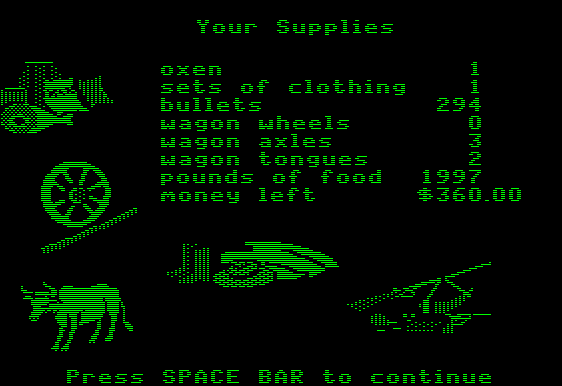
The highest claim I was able to find wasn’t from a full video, but from the above photo posted to the Oregon Trail speedrunning Discord by saizonokumo. Notice how they arrived with $360 cash as a farmer. Looks like someone had the same idea I did!
It was at this point the little light bulb above my head clicked on.
“Wait… You’re telling me… Nobody is known to have scored ten thousand on this game? Ever? Like, nobody’s just bothered to sit and grind out a higher score? That’s just… a thing… waiting there… for someone to do it?”
So I did it.

10,074 points.
New.
World.
Record.
And, the first ever verifiable score on Oregon Trail over 10,000.
It took about 20 hours of active game play over the course of three days, and most of that play was gridning trades and hunting over and over and over and over. I focused on accumulating clothes and ammunition, even through unfavorable trades, as those are the two assets with no known limit. I also took advantage of the aforementioned “wild fruit” bug to boost my food supply a couple times. For the sake of my real life health, I took breaks and slept while I left the game idling on the menu, lol. (I’m sure the “Breaks are illegal” crowd will get a kick out of that.) But I recorded all my active sessions, if for some reason you feel compelled to watch almost an entire day’s worth of the most tedious game play ever.
https://www.youtube.com/watch?v=8PkpxIHD8SY
https://www.youtube.com/watch?v=fn1o9SrDsaU
https://www.youtube.com/watch?v=Tys5BP2xjcA
https://www.youtube.com/watch?v=f7Ol4QTs8tY
https://www.youtube.com/watch?v=wFiN7jsQlRk
And as you can see, the game does handle five digit scores! Or at least, sometimes it does. The “Top Ten” chart correctly ranks my score at the top, but on that screen, it doesn’t display the leading digit:

Part of me suspects that someone out there at some point may have suffered the same curiosity as I, and ran their Apple IIe for a couple days, finding the same five-digit answer before I did – especially back before the Internet when there was no easy way to look up such things, and literally nothing else worth doing with your time. But hey, you know what they say; no vid, no did.

However, this high score is not the subheader-teased “One thing left to do”. That’s something I leave for all of you at home… But for that… I have to introduce a few…
NEW TWIN GALAXIES CHALLENGES
That’s right, it’s time for new TG challenges! Formerly called TG “bounties”. The Twin Galaxies site got a recent makeover, and somewhere along the line, their “bounty” system was renamed to “Challenges”. This was a very welcome change, as I was using the old terminology simply to stay consistent with the site I was using for adjudication, but as folks often pointed out, the word “bounty” generally implies a reward that’s not made-up bullshit. Now at TG you can find a page full of challenges, some of which would fit the traditional definition of a “bounty”.
All of this brings me back, briefly, to RetroAchievements. I’m not really big on the RA leaderboards. Nothing against them, of course. I’m glad they’re there for the folks who want ’em. They’re just not what I go to the site for. So it wasn’t important to me to do my 10,000 score for RA credit.
There is, however, a second set of leaderboards offered for the game…

Huh, most cash remaining? We’re pretty much blown that concept wide open. Indeed, I decided a couple of those were worth scooping up while the scooping was good:

Permanent first place, amirite? I left the banker one alone though, because I thought this might make a neat TG challenge, and I prefer not to fully complete the challenges myself before issuing them to you all, so the folks playing have the satisfaction of being first. Usually, that means not demystifying the challenge involved, but that was impossible if I were to put together this write-up. And yet, in this case, I think that same idea applies, just differently. The most reserve cash you can complete the game with is $1,560, by playing as a banker and succeeding with a purchase of only one yoke of oxen. That high mark is still sitting there. It is still possible to complete Oregon Trail with more leftover money than anyone else ever has (verifiably, at least). That, my friends, is the “one thing left to do”, and I leave it to all of you:
https://www.twingalaxies.com/challenges/The-Oregon-Trail-1985-Reach-Oregon-with-1560-remaining-PPMDC
Speaking of RetroAchievements, that tends to be the first place I go when I think I have a cool new idea for a TG challenge. And often, I’m met with the discovery, “Oh, my clever idea is already a standard cheevo for that game, and 340 people have already unlocked it.” Womp womp. But sometimes the site inspires me in unexpected ways. I was perusing the set list for Dragon Quest 2 on NES (“Dragon Warrior 2” to us old fogies), when something caught my eye…

What’s interesting isn’t the achievement itself, but rather that it’s not marked for progression. Many of the other achievements – “Find the Mirror of Ra”, “Open the floodgate in Tuhn”, etc – are marked with a little symbol basically saying “Don’t worry, this is required, so you’ll get it just by beating the game.” It got me thinking… Is it possible to beat the whole game without ever levelling up your starting character, the Prince of Midenhall?

After selling my Copper Sword for a bunch of Medical Herbs, I was able to recruit the Prince of Cannock without earning a single experience point. So I’d say, it probably is possible! While it would be awesome for someone to complete the whole game this way (and perhaps someone out there has), that feels a bit more intense than what I’m aiming for with these challenges, especially since these require single sit-downs. So I’m going to set the end goal of this at acquiring any two of the required five crests of your choice. Oh, and don’t even think about using funny character names to negate encounters; that shit is insta-banned.
Last time out, I made a big change to how these challenges are implemented. Previously, I had set four- or five-month windows for each bounty to close, and the challenges would be designed with that in mind. This was conducive to things like “Highest score” and “How far you can get damageless”. I’ve decided to switch to open timeframes, and so the challenges now require a more specific goal.
With that in mind, I’ve had an eye on bringing back some old challenges which received zero submissions, reformulated for this new rubric. One of these was for arcade Missile Command. The challenge was to achieve the highest score possible without using the “Delta Base” (a.k.a., the middle base):

Nobody submitted an entry, but I still think it’s a really cool idea. So I’m going to give it another chance. My amateur ass was only able to score 16,965, and that was after many attempts. This still seems pretty experimental, so it’s hard to say what an appropriate goal should be. The premise certainly breaks down in the face of later, high-difficulty levels, where you need every missile available. But judging by this three-base performance by Dave Moore, I suspect 50,000 points is a difficult but attainable benchmark.
That leaves me without a SNES challenge, and also coincidentally without having done a Zelda challenge in a while. “Link to the Past” it is! As I said, damageless runs were easy to design when working with five-month deadlines, but a little trickier when you’re looking to set a specific goal. Complete game damageless runs are a bit more difficult than I’m looking for – I’d be interested in a mark about halfway through the game. And indeed, full damageless clears have already been achieved on LttP. The speedrunner Xelna (not to be confused with xelnia of Donkey Kong legend) completed a no-damage run, with a focus on a low% speedrun route. And in 2022, YouTuber Slackanater completed a no-damage/death run, with more traditional approach, collecting most of the game’s inventory:

The notable exceptions are the blue and red armors, the bug-catching net (which is understandable, since you won’t need faeries), and… the Cane of Byrna, a.k.a. the blue cane, a.k.a. the item stashed at the end of the long spiky room of pain. And wouldn’t you know it? That room of a thousand spikes becomes available about halfway through the game.

So that’s where I’ve set the mark. I tested around, and confirmed you can cross the winding spiky hallway without taking damage, and can survive the return trip as well, but only if you have the Magic Cape, the half-magic modifier, and at least one bottle of magic refill potion. (Oh, and the dash boots, but you knew that.)
The magic modifier is necessary because you cannot refill halfway through the spikes, as switching off the Cape will result in an immediate point of damage, no matter how quickly you think you can down your green Gatorade. And that means, you’ll probably need the Titan’s Mitt to reach the magic modifier. I say “probably” because there are approximately eighty gazillion glitches on LttP, and I’m open to being a little loose on this one. You have to clear the castle basement, and acquire the three pendants, and the Master Sword, and defeat Agahnim to reach the Dark World in the traditional way. And I’m disallowing full out-of-bounds chicanery, or anything that warps you directly to the cane, or makes it attainable from any other location or through unconventional means. Either way, first to the prize gets the win.
I’ve also made one other change. The last couple challenges I opened, I set a limit of three winners per challenge, in the hopes that it might spark more participation. Obviously that didn’t work, lol. Honestly, I’m also a nice guy, and I didn’t like the idea of two people going for the same challenge at the same time, and the second person getting skunked because they finished an hour later or whatever. It’s not like we’re playing with actual money here. But going forward, each PPMDC challenge will be one-and-done. One slot, one winner. If you want it, you gotta get on it and do it. Now, if that hypothetical scenario does happen, and you do achieve the goal only to find someone else did it parallel to you except slightly earlier, reach out to me right away, and we can figure something out. I’ve got no problem giving out double-credit. But you gotta be quick with that DM, and quicker still with your evidence. If you reach out to me the next day, like “Oh dang, there was a challenge, I coulda done that”, it’s too late at that point. Hey, I may be a nice guy at heart, but I’m also willing to be the bad guy.
Thank you all for reading as always! Trans rights are human rights. Happy challenge-hunting, and happy trails!
So, you either became a total lowlife and played as a carpenter, or became a total lowlife and faked a record on RA? Which one is it? (/j if that’s not obvious)
lol You found my dirty secret.
Commodore C64 I grew up with and learned it as my first pc. even had a 300 baud modem to dial into quicklink or qlink before I realized or my parents did that it was calling long distance. Aren’t these games north west east south kind?
If it does have a high score function im sure Todd Todgers has the score that no one can beat.
I loved this game and always had a soft spot for it. Even now I have the handheld and a few other versions. After reading this I realized they missed out on making a great horror version of this: the Oregon Trail:Donner Party of Doom. lol
Great writing as always!
Thank you! lol That would’ve been amazing. I guess someone could still make it?
Oregon Trail was recently datamined by people who were trying to see if they could survive for 15000 years, writing bot macros to repeatedly skip time.
https://moral.net.au/writing/2025/01/11/waiting_for_oregon/
What they found provides an interesting limitation to max score runs. If you wait all the way to the year 1900 in the unmodified game, the year will display correctly on the status screen, but on the victory screen it’ll say you reached Oregon in the year “18100”. Furthermore, if your run goes out to the year 2056 or later, the game will crash upon trying to display the victory screen, preventing you from receiving a score. Therefore, you’ll want to start in March to have the greatest window of time to spend looking for trades, and make the final dash to the Dalles right at the end of 2055 (or 18255 as the locals call it) after accumulating as many resources as you can by then.
Oh that’s interesting!! I totally missed that. Thank you!!
I’m from Minnesota and my experience on Oregon Trail was on the early build. Thanks for making me feel ancient.
Hahaha, any time friend! That’s legendary though, to get in on something cool like this right when and where it started.