
by ersatz_cats
Welcome back, folks! I’ve got kind of a half-update for you all today. (Well, I guess my “half-update” would be anyone else’s double-length essay, lmao.) I wasn’t intending to come back so soon after the last big report. I was gonna wait until after the next key ruling, play a little Final Fantasy 5 in the meantime, and catch up on all the motion replies and such in one big batch. But stuff keeps getting crazier, and this just cannot wait.
As a reminder, this is all about Karl Jobst’s new lawsuit against infamous gaming fraud Billy Mitchell in Florida. Billy has appointed his own daughter Michele to represent him, and “Mish” has already filed two motions to that end – a motion to require Karl to put up a security bond (“Motion for Security Costs”, or “MSC”), and a motion to dismiss Karl’s case entirely (“Motion to Dismiss”, or “MtD”). Karl responded by pointing out the many deficiencies in both motions, including that Michele’s own case law citations work against her. Honestly, just check out the previous update for all the deets on that. The point is, Michele’s stuff wasn’t making any sense. I mused she could be using generative AI to write her filings for her, and a free tool seemed to agree to some extent. But as we’re about to see, her submissions have only gotten worse. To put a spin on an old maxim, it’s not like she can stay silent, and what she does have to say is removing all doubt.
Oh, and as the last update was being finalized, we got some late-breaking news that Michele had been dropped by her firm entirely. Of course, employers don’t typically comment on these things, but it certainly looks like she was terminated. We can’t say for certain what did it. Was it her Twitter activity? Did her bosses smell the same AI scent I do? I think a look at further developments may give us a better indication toward that as well.
Oh yeah, as usual, I do not speak for Karl Jobst, yadda yadda.
BUT THAT TRAIN KEEPS A-ROLLIN’
On June 19th, Michele Mitchell filed replies to Karl’s two opposition briefs, in an attempt to defend her two still-pending motions:
We’re only going to have fun with these this time. We will not be doing a detailed point-by-point walkthrough of either of Michele’s replies today, for a few reasons. First of all, these are bad. As we’re about to see, Team Billy has escalated from mere ridiculousness and misrepresentation to brain-melting psychosis. And yes, you are encouraged to wear your safety goggles, not only because what you will see is radioactively dumb, but also to protect against any residual assimilation virus Michele’s robot handlers may have left behind.

To be serious though, these are both replies, and it turns out there are restrictive rules about what you may argue in a reply brief. Here’s a link to what are called “Local Rules” for U.S. District Court in the Southern District of Florida. This is where we find stuff like page count limits and filing deadlines. And here are the instructions on what a movant (the party putting forth a motion/request to the court) can and cannot do in response to an opposition brief:
The movant may, within seven (7) days after service of an opposing memorandum of law, file and serve a reply memorandum in support of the motion, which reply memorandum shall be strictly limited to rebuttal of matters raised in the memorandum in opposition without reargument of matters covered in the movant’s initial memorandum of law.
So procedurally, these replies should only be responding to points raised by Karl in his opposition. That makes sense, right? The court doesn’t want an endless universe of argumentative people trying to get the last word by reasserting the same rhetoric ad infinitum. Karl gets to respond to the motion to dismiss or whatever, then Billy’s side can reply, but their reply has to be limited to countering points raised by Karl. And if Mish had followed these procedures, I could attempt to take her replies seriously, but she does not. This is another reason why I’m not going to waste your time and my time, not to mention our sanity, delving into these new filings in great detail. Honestly, if Michele had a valid argument to dismiss Karl’s case, or to require a security bond, we would have already seen those arguments in her original motions.
Indeed, both replies fail to clear this minimal hurdle almost immediately. They spend most of their time relitigating the same points and arguments from the original motions. Okay, whatever, the court probably tolerates some of that. But what’s telling is that neither reply directly cites Karl’s opposition briefs a single, solitary time. What I mean by that is, there are references to Karl’s opposition, in the form of sweeping generalizations of what that opposition is supposedly arguing, but no specific passage is ever quoted or pointed to. You can find a few citations of the First Amended Complaint – “FAC at 1”, “FAC at 32”, etc. But Michele is not responding to a single specific thing from either opposition brief… even thoughhhh… that’s supposed to be the entire point of these replies.
Here are some examples of broad, uncited generalizations these replies offer:
Plaintiff’s Opposition confirms, rather than refutes, the need for security in this case. Plaintiff is a foreign resident, is currently in bankruptcy, and has expressly disclaimed the ability to satisfy an adverse cost award. At the same time, he seeks to pursue litigation against the very party that holds a substantial outstanding judgment against him, arising from the same course of conduct.
Karl has not “expressly disclaimed the ability to satisfy an adverse cost award”. That’s just a lie. Remember, we’re talking about something of unknown dollar amount, possibly years into the future. If Mish cited a passage from Karl’s opposition, we could follow it to see what the hell she’s talking about, but of course she does not.
Also, what is this “arising from the same course of conduct”? What does that even mean? Was Karl accusing Billy of defrauding specific dollar amounts from his audience? Was Karl selling lobster prints of Billy and using his name and likeness to sell hot sauce? This is what I’m saying. No human, not even a lying one, writes this passage. And even if you wanted to entertain this insanity, Karl lost the Australia lawsuit. So if we’re dealing with “the same course of conduct”, would that not also imply that Billy should lose this case? How could Michele possibly sit down and think “This is a good thing to write”?
Plaintiff’s Opposition instead seeks to transform this legal inquiry into a factual dispute by emphasizing the number and detail of allegations, including references to reports, testimony, and timelines.
This made me laugh, because it reads like “The Opposition is trying to confuse you with piles of documented evidence.” Sure, you could say this is a “legal inquiry”, and that inquiry is “Does Karl have a prima facie case based on the available facts and evidence?” Karl supplies both of those, and relevant law. Michele does her best to pretend none of that exists.
Someone should tell Mish that the “Chewbacca Defense” is a television joke, and not a viable way to proactively request considerations from the court.
Plaintiff’s position would effectively eliminate any meaningful protection for defendants in cases involving insolvent foreign plaintiffs. Under his theory, a plaintiff could pursue litigation without financial capacity to satisfy an adverse award, leaving the defendant to bear the full cost of defense regardless of outcome. That is precisely the scenario that security-for-costs orders are designed to prevent.
Also made me laugh. “But your honor! This would open the floodgates! Anyone could sue anyone for anything, and all they’d have to do is become destitute and declare bankruptcy first.”

Yeah, lawyers are notorious for not caring if they get paid. While Michele’s reply is busy conjuring hallucinations and playing mind games, she conveniently fails to respond to a rather important point raised by Karl, which is that the probable merits of a case are a key factor in determining whether a security cost is warranted. One big reason Karl is thus-far able to pilot this lawsuit cheaply, without an attorney, is because the evidence is overwhelmingly in his favor.
Plaintiff’s Opposition attempts to isolate particular words—such as “fraud” or similar characterizations—and treat them as literal assertions divorced from their surrounding context. But courts have consistently rejected that approach. The meaning of a statement cannot be determined by parsing individual words in isolation; instead, it must be assessed from the perspective of a reasonable viewer encountering the statement in its full context.
This is insaaaane!! Yes, this is an actual thing, actually included, in Michele’s actual reply. Remember, Michele’s motion to dismiss tried to reduce the defamatory statements to a single word. And Karl had to be like “Plaintiff is not basing his claim on a single word. Each publication involves many words, with each extra word providing further meaning.” Karl himself emphasized the context of Billy’s remarks (“I think if I did that, I’d probably be in jail”, etc.), while also pointing out that the words Billy uses to accuse Karl come straight from Florida’s theft statute. Even though the overall premise is not especially complex, Michele’s AI has no idea how to parse all this, and so it conjures up something any sane person in Michele’s position would be too embarrassed to attempt to argue.
(Also note the unnecessary double em-dash. We’ll get to that later.)
The question before the Court is whether security for costs is warranted based on the risk of non-payment and the equities of the case. Plaintiff’s references to online commentary, tone, or perceived litigation conduct have no bearing on that analysis. Courts evaluating motions for security for costs do not adjudicate collateral disputes regarding speech or counsel conduct; they assess practical considerations such as residency, financial capacity, and the likelihood of cost recovery.
Speaking of lack of self-awareness. I’m old enough to remember when Michele was the one who attached the Barlow ruling for no discernable reason other than to cast Karl as a “crusader”, while twice emphasizing the “unusually personal and adversarial nature” of their dispute.
Plaintiff acknowledges that his disclosures regarding litigation and fundraising were, at times, incomplete, evolving, or later clarified.
Where? Where? Wherewherewherewherewherewhere? Where did Karl acknowledge this? What disclosures?
Let’s be clear. Karl said Billy’s statements “may be reasonably understood as assertions of fact, or at minimum as opinions implying undisclosed defamatory facts”. Because remember, this isn’t about what the public did or did not yet know. This is about what Billy knew, as Karl’s creditor. But Michele’s reply now argues that disclosures were incomplete, and thus Billy “[drew] inferences from publicly available information”. As near as I can tell, that’s the only bit Michele’s acid-tripping AI would have drawn this inference from.
The filing attempts this same line again later, but even more bizarrely. Check this out:
Plaintiff acknowledges that certain details were not fully disclosed, that aspects of his communications were later clarified, and that his public narrative developed over time. He further admits that he did not disclose certain information, including the details of a settlement offer, and has offered shifting accounts regarding litigation costs and funding.
“Settlement offer”?
You do realize that Billy would necessarily have known about any settlement offer from Karl, no matter how publicly undisclosed it may have been… right?

This incorporation obscures which specific statements and factual allegations are intended to support each count, and forces Defendant and the Court to sift through a mass of allegations to determine the basis of each claim.
That’s a lie.
The allegations do not plausibly suggest that Plaintiff’s identity was used as a stand-alone commercial asset or to directly advertise a product.
That’s a lie.
The Amended Complaint does not plausibly allege that Defendant used Plaintiff’s identity to suggest Plaintiff’s sponsorship, approval, or endorsement of any product. Instead, Plaintiff alleges that references to his name and likeness appeared in connection with videos, posts, and related content criticizing Plaintiff.
That’s a lie by omission. Remember, “suggesting endorsement” and “appears in expressive content” are not the only two possibilities. Recall also that the relevant Florida statute does not give any consideration to whether the unauthorized use of name and likeness implies “sponsorship, approval, or endorsement”. Also, these two sentences are mild reformulations of two successive sentences in the motion to dismiss, which Michele is not supposed to be rearguing.
There is so much hallucinated insanity in these replies, I’m just going to have to skip a bunch of it, or we’d be here all day. (I say that as I keep adding things to my draft list anyway.) Once again, if Michele had a valid case for these requests, we would have seen it in the original filings. So as long as you keep those goggles securely fastened, you can poke around and find more nonsense for yourself.
However, there are a couple running themes from Michele’s MSC reply I’d like to point out. Over and over, the reply blindly asserts, with no cited authority, that federal courts in the relevant jurisdiction not only do grant motions for security costs, but do so regularly. “That authority is routinely exercised”. “Courts routinely exercise this authority”. “[I]t is a routine and necessary safeguard.” This feels like a toddler who has realized they can maybe sneak one past mom by saying “But dad always lets me do it!” Surely, if this practice is so routine, Michele could cite one or two recent, accessible examples… right?
Well, apparently no. Instead of such examples, the reply chooses to reargue the merits of “Aggarwal” and “Simulnet”, two cases which we discussed last time. Remember, these were the exact two cases where a security bond order was overturned on appeal because it represented an undue imposition.
This brings us to another AI-style delusion in “Michele’s” filing. It argues that Karl was building its case against a security bond on an invocation of Aggarwal. So the filing says, Karl’s “reliance” on Aggarwal is “misplaced”:
Plaintiff relies heavily on Aggarwal to argue that his financial condition automatically shields him from a cost bond requirement.
Except a human writing this (not to mention a human reading this) will understand that Karl wasn’t actually “relying” on Aggarwal. It was Michele’s MSC that invoked Aggarwal eight times – more times than Karl did in his opposition. What Karl was doing was pointing out the ways in which Michele’s own cited precedent actually undermines her case. You’re allowed to do that, right?
It’s at this point that Michele’s ChatGPT has an even bigger and more obvious brain fart:
This case presents the exact opposite landscape contemplated in Aggarwal.
“The exact opposite landscape”, huh?
Then why did you bring up Aggarwal in the first place?

I do feel compelled to briefly discuss Michele’s only new citation toward MSC, “Hawes v. Club Ecuestre El Comandante”, a Puerto Rico case which Mish’s filing claims “[affirms] imposition of bond where plaintiff’s financial condition created risk of nonpayment”. I wasn’t able to find the actual ruling through my free resources, and I ain’t paying for this shit. I found two references to the ruling, both of which quote it as saying “to require all foreign plaintiffs, as such, to post substantial security as a condition to access to the courts may well be an unconstitutional denial of equal protection”. Nothing I’ve seen refers to any “risk of nonpayment”. Still, if the purpose of this was to establish the claim that federal courts in the southern district of Florida “routinely” require a security bond, I would expect more examples than a single case, from out of state, from 1976. Holy shit, that’s older than me, and I’m so old I remember watching Snorks on Saturday mornings!

There’s one other recurring theme in this filing that simply cannot go unremarked. See if you spot the pattern in these passages:
Rather than an innocent litigant seeking access to the courts, Plaintiff seeks to pursue additional litigation against the same defendant while disclaiming any ability to satisfy an adverse cost award.
Plaintiff is now in bankruptcy as a result of that judgment, yet seeks to initiate additional litigation against the same Defendant while disclaiming any ability to satisfy an adverse cost award.
This is not a case involving an innocent litigant seeking access to the courts; it involves a foreign judgment debtor attempting to pursue successive litigation against his primary creditor without financial accountability.
Critically, Aggarwal limits its protection to circumstances where there is “no history of the persistent pursuit of fruitless litigation…
Under his theory, a litigant who has already been adjudicated liable, remains subject to a substantial unpaid judgment, and resides outside the jurisdiction could initiate successive litigation against the same defendant without any meaningful financial exposure.
“the same defendant”?
“successive litigation”?
“persistent pursuit of fruitless litigation”?
HOLY SHIT, this author thinks KARL was the one who sued BILLY in Australia!
That’s what that means. When you say someone is “pursuing successive litigation”, you mean “This person keeps filing lawsuits”. When you call someone “the same defendant”, what you mean is “They were the defendant before, and they are the defendant again”. And when you say “Plaintiff seeks to pursue additional litigation against the same defendant”, you mean “He won’t stop suing my client.”
Now, I’m sure Michele would love for this court in Florida to have such a wild misunderstanding of the nature of the Brisbane proceeding. And she is Billy Mitchell’s daughter, so lying is in the blood for her. But this would be a bit too clever, wouldn’t it? I mean, she already attached the Barlow ruling that shoots this down. Again, no human who knows the backstory writes this. You discredit yourself the moment the judge takes an even cursory look at the case. Why do you want the judge to see you as the attorney that tells a bunch of pointless, bald-faced lies?

We’ll wrap this part up with a sentence from the conclusion of Mish’s MtD reply, which gave me yet another chuckle:
At a minimum, if the Court does not dismiss the claims on the merits, it should require Plaintiff to replead in a manner that clearly isolates the specific statements and factual allegations supporting each count.
Why would you say this? That pleading you describe? Where specific facts and statements are tied to each count? That pleading already exists. The court has it. You have it! I get that she files a motion to dismiss because she wants to get lucky and get some of Karl’s counts arbitrarily tossed. That’s just court stuff. But why proactively offer this visage of the version of Karl’s complaint that would pass muster, when your description matches the actual complaint and not the made-up scarecrow boogeyman you’re shadowboxing against? Does Team Billy believe their own lies? Is Michele bothering to proofread whatever text her pal Claude spits out?
CHIN MUSIC
So here’s where we get a peek behind the lawyerly curtain, as it were. A few days after these replies were posted, Michele filed amended versions of each reply. Why? We’ll get to that. (This is like one of those Star Trek time paradox episodes where everything you see is out of sequence.)
In order to do amend these filings, Michele had to ask the court’s permission, which they call “leave”. So both were filed as two-fers: Basically “May I please amend this reply, and also, if that request is granted, here’s what I wish to amend it to.”
As of this writing, the court has not weighed in on any of this, but apparently Karl did not oppose this request for leave. So the fact that Michele is going back and correcting her motions is not at issue. However, certain things about these replies very much are at issue, and have prompted a response from Karl.
Here are links to the amended replies, if you’re still wearing your safety goggles, and are curious what they look like:
So… What exactly changed?
Almost nothing, lmao.
So… Why change it?
If you’re confused, that’s fine. All of this is trickling from the court site in a nonsequential fashion. If we skip ahead a bit, we can find clarity to these questions at the end of Karl’s two newest motions. Karl has requested the court strike both of Michele’s replies for failure to adhere to the basic court rules we referenced earlier. At the end of these motions, Karl includes a “Certificate of Conferral”, essentially saying “I pointed all of this out to opposing counsel, and they told me to fuck off.” Or rather, here’s the actual text from one of those motions:

Check out this bit lolololololol:
Defendant amended the initial reply to cure the page length deficiency…
That, my friends, is the entire reason why these amended replies exist. Michele didn’t know the page count limitation, and said “Oh shit, I’m not going to bother changing all the other stuff which I can’t fix because I have no idea what I’m doing, but that one’s a hard rule, so I’d better correct that.”
Aaaaand… Apparently she did not know this already, and needed Karl to inform her. And I guess her ChatGPT did not pick up on this either.

We’ll discuss the rest of Karl’s strike motions in a moment. First order of business, Michele had to correct her “page length deficiency”.
So what did she do?
You want to guess?
You already know the answer, don’t you?

That’s a passage from Michele’s original reply, followed by the same passage from the amended reply. I added the greyscale Trumps as a measuring reference.
That’s right, Michele just changed the font size and resubmitted it hahahahahaha.
The court rules Karl invoked clarify that “a reply memorandum shall not exceed ten (10) pages”, but that things like service pages and requests for hearing don’t count towards those ten “[a]s long as no substantive part of the submission appears on the same page(s)”. Notably, I think Mish is still in violation, because her “Conclusion” section is on page 11, and conclusions don’t seem to be among the listed exceptions. But setting that aside, the meat of the reply fills those ten pages to the brim. It’s not hard at all to tell what happened here, lol. Indeed, if you scan through, you can find like three passages toward the beginning and end that were streamlined juuuust enough to slip under that page count:
The Motion addresses the categories of statements identified in the pleading and applies controlling constitutional and Florida law to show that those statements constitute protected opinion, rhetorical hyperbole, and non-literal expression.
The Motion addresses the challenged statements and applies controlling law showing they constitute protected opinion, rhetorical hyperbole, and non-literal expression.
I guess all that English Lit padding wasn’t so helpful after all. The original MSC reply was two pages shorter than its MtD sibling, so extra measures weren’t necessary. Literally the only things that were changed there were the font size, and the date of filing.
At any rate, if you still entertained thoughts of “Well, Michele’s an actual attorney, so she must know what she’s doing,” you now have your answer. She definitively does not.
And that brings us to Karl’s motions to strike both of these replies:
Karl is quick to invoke Local Rule 7.1(c)(1) we read earlier. He points out that Mitchell doesn’t even particularly attempt to address the opposition brief, which is required of a reply memorandum:

Over on the MSC side, Karl doesn’t hesitate to point out where Michele misrepresents him, and where she attempts to improperly reargue things she herself acknowledges were not raised in Karl’s opposition:

Both of Karl’s motions to strike are brief. (Har har!) He covers much of what I’ve already outlined, including the bizarre characterization that Karl is suing “the same Defendant” again:
Again, not only did Plaintiff not disclaim any ability to satisfy an adverse cost award, but Plaintiff has never initiated any litigation against anyone prior to this case, and certainly not against Defendant. Not only are these theories that should have been raised in the MSC, but they are materially false and unsupported by any evidence.
And that wasn’t the only new line of argumentation that belonged in the original motions, rather than a reply:

Karl observes how the reply melts down into a more personal-focused screed (which again is ironic considering the reply simultaneously attempted to claim the high road):
Defendant repeatedly attacks and mischaracterizes Plaintiff’s intentions and the nature of this action in order to turn a procedural request for security into a vehicle for which he can unload his personal grievances to the court.
I’m sure judges looooove that sort of thing. Karl continues peppering in just that right amount of snark, pondering the implication of Michele’s own choice of words:

If I understand it correctly, Karl doesn’t get a formal opportunity to respond directly to the reply. Again, we don’t need a universe of replies-to-replies-to-replies-to-replies burrowing down to the center of the Earth. Someone has to be given the last word. But that’s why reply rules are so restrictive. As an attorney, Michele ought to know this. And while Karl is not given the platform of a formal reply, there are mechanisms to correct exactly this sort of misconduct. (If there weren’t, attorneys would give little thought to abusing reply opportunities all the time.) Karl is absolutely in the right to say “No, you cannot fucking do that, that’s not how this works.”
Plaintiff is regretful that such a motion to strike is necessary, and if the Reply was merely a reargument Plaintiff would not feel it prudent. However, the added admissions and acknowledgements attributed to Plaintiff that seem to have been concocted out of thin air would be extremely prejudicial if accepted by the court.
Can I get a steeeeeeeeeee-rike?

WE ARE THE ROBOTS
Okay, it didn’t take long for Michele T. Mitchell to get utterly exposed. She’s bad at her job, she doesn’t know procedure, and doesn’t know the relevant law, probably because she has no experience in defamation. Amusingly, whoever wrote her “unclaimed profile” at experience.com, which is now two firms out-of-date, also didn’t seem to know what she’s actually good at:
Michele Theresa Mitchell is a skilled lawyer attorney at Wood Smith Henning & Berman, bringing dedicated legal expertise to clients in Orlando, Florida. With a focus on [mention area of law if known, else remove this part], Michele provides comprehensive counsel and representation.
I’m going to assume Michele’s worse at writing than ChatGPT, because otherwise her filings would be written by a human. (Unless she just can’t be assed to spend the time.) Oh, and her most recent law firm went from “Let’s assign our firm partner to help you with this worthwhile case” to “We don’t know you, we never knew you, we’ve scrubbed your name and changed the locks, don’t bother turning in your keys.”

Last time out, I was more just having fun with the AI stuff. “Ha ha, her writing makes no sense, and this thing says it’s AI-generated.” I even said you don’t have to take the tool I was using seriously. But her filings have only gotten more nonsensical. There are no technical typos, but there are so many head-scratchers. That same tool gives mixed scores this time, with some sections scoring low and some high. But an automated AI-checker isn’t going to understand when the filing is misrepresenting facts or case law, or misarguing their case, or just hallucinating shit out of thin air. Admittedly, it can also be hard to differentiate between “misrepresentative because it’s AI-generated” and “misrepresentative because an attorney is deliberately trying to slip one past the judge”.
Of course, there aren’t any overlooked AI-prompts, such as “Would you like more ways to pad out your hollow motion to dismiss?” Without something blatant like that, I’m not sure how one would go about proving anything. Supposedly, overuse of em-dashes can be a sign of AI-authorship. And the new filings have a few em-dashes, which I think ought to be just commas or semicolons. Looking back at Michele’s original MSC, I find no em-dashes, but there is some very curious misuse of ellipses:

LMAO
Here we have it twice in one sentence!

Remember how Billy Mitchell knew he was lying about his Donkey Kong tapes? He knew he was trying to pass off MAME as original arcade, but he also knew things like the audio and the “rug pattern” would give him away, so he deliberately excluded these telltales from his tapes. Now, let’s say Michele knows she’s having ChatGPT write these filings, and she knows that’s super-bad, so she wants to hide it from the public and her firm. And even though em-dashes are normal English, they’re also known as an AI giveaway, so she goes out of her way to scrub them. And since she doesn’t know how to rewrite anything herself, the only thing she can do is replace em-dashes with ellipses, even though the way she does it is totally improper. (I’m aware I use ellipses for comedic effect, but that’s not the same thing.) Listen, it’s either that, or a human being doing real human writing sat down and said “I’ll throw a back-to-back ellipsis into this sentence, for no reason, in a way that makes no sense, but which looks just like I’m trying to hide that some robot wrote this shit.” Say, is that why the original filings have almost no case law citations? Did Michele have to go through and delete all the ones Gemini conjured for her? “Oh, that case doesn’t exist. Oh, that one too. Oh, there’s another.” Did she have to instruct the AI to stop attempting case citations altogether?
Again, I’m not sure how you’d technically demonstrate AI-generation here. But just reading her filings, once you know to look for artificial-brained idiocy, it’s the most obvious thing in the world. And it’s only gotten worse. I can’t prove it, but maybe this doesn’t need to be proven. I don’t know how keen judges currently are on this stuff yet, but they have to be recognizing some AI nonsense that comes across their desks. Even if you set that question aside, her filings aren’t cogent and purposeful like Karl’s. It’s all “Herpaderp Plaintiff doesn’t specify the allegations trust me bro.” I couldn’t tell you at which point judges respond negatively to people who waste their time, but I know that at some point they do.
Straight up lying to the court would seem to violate the oath Michele took as a member of the Florida bar:
I will not counsel or maintain any suit or proceedings which shall appear to me to be unjust, nor any defense except such as I believe to be honestly debatable under the law of the land;
I will employ for the purpose of maintaining the causes confided to me such means only as are consistent with truth and honor, and will never seek to mislead the judge or jury by any artifice or false statement of fact or law;
How do I know she’s seen that?
Because she happily posted a photo of herself the day she signed that very oath:
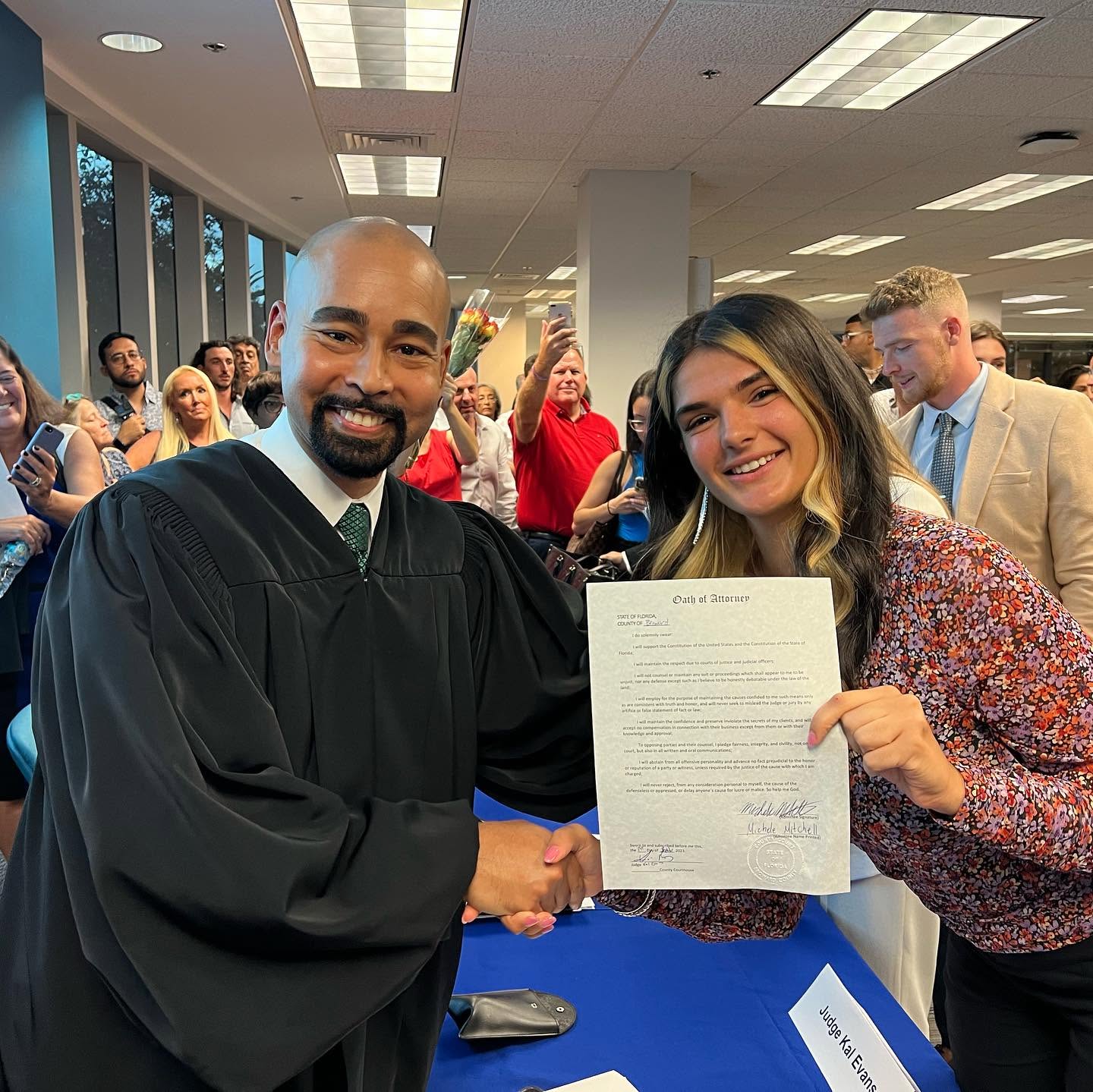


Look, I couldn’t tell you how often any attorney gets in trouble for stepping beyond the bounds of expected fierce advocacy. But I can tell you I’m not the only one who thinks there’s something here. I came across Rule 11 of Federal Rules of Civil Procedure, which governs things like misrepresentations to the court, and how lawyers are “sanctioned” (punished) for misconduct. This passage especially stood out to me:
Absent exceptional circumstances, a law firm must be held jointly responsible for a violation committed by its partner, associate, or employee.
Hahaha, No wonder her firm jumped ship on her! It’s one thing when it’s a free roll, helping your junior associate defend her father. It’s a whole ‘nother thing when you read her slop pleadings and realize you may be getting whacked by the same gavel coming for her.
The motion to dismiss was kind of a blank slate, in that Mish could more-or-less argue what she wanted. But the reply format has more restrictions; if anything, it showed she doesn’t know how to write to those kinds of constraints. And things are only going to get more restrictive from here. Is Michele going to fight these motions to strike? She kind of has to, or else they’re unopposed. But does she know how to effectively oppose them? She didn’t know how to handle Karl’s opposition, or how to write a functional reply, so I’m not convinced. Will her AI know how to respond to a motion to strike? How much worse will her filings be now that she lacks the firm’s legal resources (which may have included the AI platform Michele had been using)?
We will find out. Again, you can’t always predict judges. I’m not holding out huge hope for Karl’s strike motions, simply because the judge has the option to disregard nonsense without an official strike ruling. But on the legal merits, Karl should win a clean sweep against the motions for dismissal and for security costs, on all counts.
Like I said, a short-for-me update today. While I intend for these reports to always go into as much detail as I deem necessary, I’m not planning on doing frequent standalone updates on every single reply that gets filed. I’d prefer the site not consist of hundreds of small posts, all pushing each other off the front page. But Mish’s AI slop was too sloppy not to serve up for you all right away. Site replies here will often reflect more recent developments. Or as long as you got your goggles on, you can check CourtListener, where all these raw filings and rulings get posted. Thanks for reading as always! See you all back here next time.
They say an absolute legend lost the first battle to win the war against the Great Big Face alien
It’s Giant Bearded Face, rookie. Next time, do your research while I find a way to drag more of my family into my legal issues. No, I don’t care about that episode. I never did. I basically won the Cartoon Network case, in case you were wondering, and there’s a promo code you can use for my sauce. It’s #NotGBF for 25% off, and no, I’m not asking for money because I’m strapped for cash. I’m rich, unlike that Jobst loser that can learn from his mistakes and grow as a person. Please check out my Cameo. I’m a Pac-Man legend, and you can call me the King of Kong if you really want to. Seriously, go ahead. I don’t mind. I have more promo codes for my hot sauce, by the way.
Let me just say, from personal experience (the lowest form of source), that the courts knows in most cases of AI has been used. They expect it. Most courts have nothing against it, if it adds anything of value. But using AI and not knowing what you’re writing or even trying to say yourself is a sin. It will give you no free passes from the court. And if you’re a lawyer using AI and don’t check your sources, you are immediately on that courts unofficial “black list” as a time waster and a thief. A time waster for obvious reasons, and a thief because these people have clients that pay them to provide a service, which they simply don’t do, effectively stealing their money.
It isn’t so much about being a ‘thief’ as it is that anytime you submit a motion to the court you’re tying it to your personal reputation. You are signing on saying that everything above is true and correct to the best of your knowledge, which you can’t really do if you *haven’t read it*.
A big fear the courts have is that one of these hallucinated citations is going to slip through. A judge is going to see “Blah v blahson’ and not look it up and instead make a ruling off what it purports to say. Then later on someone is going to look at *their* case and go “Ah, well in Steve v Bob they found that…” and all of a sudden they’ve created precedent based on a lie.
Until the Judge gives an official ruling on these motions, we have no way of knowing if Karl or Billy wins. But no matter the outcome, we can guarantee Micheal Bitchell loses. Michele’s hilariously embarrassing conduct during this case will not be good for her reputation.
Looking at Michele’s Florida Bar profile, she now appears to list herself as working at MTAM Law, PLLC. Based on the Google maps listing I assume that this is a company set up by her personally.
Bizarrely there is a 5 star review that was posted at a time where she was supposedly working for her previous firm.
Michele
Theresa
Ann
Mitchell
Law PPLC
Maybe Todd Todgers should give her a call
Yeah, that’s like her personal platform, named after her initials. I’m not sure exactly how that works, with a lawyer belonging to a firm but also having side stuff. Either way, after failing to stick on at multiple firms, she may be relying on that platform a lot more going forward.
I must say, it’s fun to argue with the Bitchell family’s meat riders! Especially with how this case is going, being able to add the fact of Silly ruining his daughter’s career to the list. Granted, that’s not quite correct, with the termination likely being caused by Michele’s own incompetent actions, but still.
Also, can we reclaim the “Erscat is insane” soundbit for the expression of appreciation for your detailed coverage of the situation? It still can’t leave my mind 😉
lmao That’ll be fun to dig up if I ever get to doing another YouTube video.
Mish submitted a couple of new responses today, though only the first one was RECAP’d so far. And holy cow, that’s not a fistful of quarters but a mouthful of terms: “DEFENDANT’S RESPONSE IN OPPOSITION TO PLAINTIFF’S MOTION TO STRIKE AMENDED REPLY IN SUPPORT OF MOTION TO DISMISS”! I’m neither an American nor a lawyer, but for once she did include some legal standards—would like to see what the veracity of them is.
Thank you! Looks like it’s all available for free now. Just more insanity from Mish, lol. I don’t know if Karl will bother replying, but I won’t worry about covering it all until my next update.
I think she has him on at least procedural error that he can’t motion to strike something unless it’s a pleading, while motions and responses aren’t pleadings.
Not sure if that’ll do anything beyond annoying a judge with having to deal with things they don’t have to.
One interesting thing in it, however, is Mish’s motion for leave to amend her replies. Submitting a motion requires acknowledgement of corresponding with opposing parties to try to resolve any issues, and she says she corresponded with Karl and he didn’t oppose leave. However, in Karl’s motion to strike he does say if she submitted that motion, he would submit the motion to strike, which does sound an awful lot like opposition to me, to my admittedly inexpert eyes.
The only problem with that is he said that was done on 6/23, which is the same day as Mish filed the motion to amend for the MTD, but the day before the motion to amend the MSC.
I have no idea what will happen regarding that, hopefully it doesn’t mean Karl’s issues with the motions are ignored.
The issue is that Karl didn’t actually *oppose* it. Oppose has a legal meaning in this context.
If I submit a motion it can be either opposed or unopposed. An unopposed motion means that the opposition is not going to submit a brief as to why something shouldn’t be allowed, an opposed motion suggests that they will.
To give a real world example, another case I followed had a plaintiff submit a request to the court asking for the court to do something with an uninvolved third party. The defendant thought it was stupid and told them as much, but didn’t oppose it and instead was going to leave it up to the judge. Then the plaintiff filed it with the court and it was substantively different from what they ran past him at which point he went “Whoh, whoh, whoh, lets try that again, we obviously oppose this” and it had to go through the whole briefing process back and forth as to whether or not it should be allowed.
If Karl doesn’t oppose her motion being filed (which he didn’t) then he’s agreeing that while he might dispute the facts within, there is nothing *proceedurally* wrong with it. He can’t then go back and say “Well actually half of this shouldn’t have been allowed”.
This is why you really need a lawyer, the rules are complicated and words that mean something to a normal person can mean something very different to a court.
I’m not the lawyer, so I can’t speak to how these processes actually play out. But it seems Karl makes a good case for why the reply was indeed procedurally wrong.
Now that you mention it, I’m now somewhat concerned that Karl might be falling into the TAB trap that Ersatz had mentioned in the first post on this lawsuit. Karl’s main weakness, I think, is his over-confidence on things he isn’t an expert at, and reluctance in admitting mistakes or faults. Things like very speedy replies to everything, trying to strike every reply, not wanting to hire lawyers (I do understand he’s bankrupt and thus broke, but still). And if you remember the previous lawsuit, he bragged on a podcast about how he wasn’t going to be a graceful winner, which contributed to an (admittedly stupid in many other ways) impression on Judge Barlow.
That is pretty much my take, yeah.
I don’t think he is *wrong* in suing Billy here. I don’t know enough about the severe emotional distress/likeness use charges to feel confident talking about them, but I’ve spent a decent chunk of time reading up about defamation over the years, and I do think Karl has Billy pretty heavily trapped on at least two counts (the first count regarding mortgage fraud and the one regarding David Race).
The issue is that he’s running the risk of severely hurting himself by *looking* petulant. The other side is casting him as someone with a severe personal grudge against Billy and a vexatious litigant. Quibbling about page counts and trying to swat down their pleadings comes across as that exact sort of pettiness, particularly when the latter isn’t being done properly in the first place.
I want him to win, because screw Billy, but if he wants to win he needs to act like a measured, rational adult, not someone snipping at their hated enemy.
Just as an aside re: AI use in court, a judge in Mississippi recently had to do some censuring of lawyers for failing to check the work of AI in their filings. All four lawyers involved got removed, each side had a lawyer barred from appearing in the district for two years, plus some fines all round.
Silly stuff!
Feel free to leave her a nice review.
Encouraging people to leave a fake review on her page is weird. At the end of the day, she’s a professional doing business. Let the case speak for itself.
So for what its worth, I think the motions to strike are… unwise.
From a purely rules base point of view, they’re almost certain to get tossed. Motions are not pleadings, and Rule 12(f) only relates to pleadings, not to motions. If Karl wanted to pursue this, the appropriate remedy is probably something closer to Rule 11(c), but even that isn’t something you want to do, especially this early in litigation.
Typically speaking, the court wants you to act like adults. Despite the reputation of lawyers as loophole loving losers, they typically want you to be as congenial and respectful as humanly possible. They want you to act like adults, with the court acting as a mediator when things fall apart.
Going “Hey, you went too many pages” is technically correct, but unless it is excessive its basically a dick move to do it and makes you look petty. Trying to strike a motion after conferral because you don’t like what is in it will likewise tend to blow up in your face, even if what is in it probably shouldn’t be there. If they’re just restarting their arguments, then let them, it’ll be obvious to the court that they’re not addressing the matter at hand.
I know this is very personal for Karl, but this is the exact sort of behavior that pissed the judge off in Australia and got him hit with such a heavy penalty. You *want the judge to like you* not see you as a pain in the ass, because judges are as human as any of us and subject to all the same foibles.
With regard to AI…. ehhhhhhhhhhh.
I use em-dashes all the time. Most professional writers and lawyers do. They are a useful part of the English language. They stick out in AI usage because they started showing up in the hands of people who had never, in their entire life, even considered an emdash. Her stuff shows up high on ‘is this AI trackers’ because formal writing tends to look like AI because AI writes formally.
The main tells of AI writing in any sort of formal writing are obviously wrong citations (which *is* something she should be concerned about), and ticks like “Not x by y”.
There is a 99% chance that zerogpt ai chekcer tool is sloppatology slopped out by sticky CLAUDE himself… it just dont look right. it even got link to SLOP “top-10” articles on front page. with webdev in 2026… slop is always.on the MENU.!!!
We have two new replies from Karl, supporting his two strike motions. I’ll save a full breakdown for my next update ,but these are spicy lol!
https://www.courtlistener.com/docket/73162164/jobst-v-mitchell/
Hello Ersatz! Just wanted to ask a couple of questions. I’ll immediately admit that I don’t know much about American laws and such.
1. With the correspondence between Karl and Michele now mostly being motions on strikes on motions on all the other layers there with little relation to the original complaint by Karl, do you think there may be a concern that this would be taken as a TAB case (as you mentioned in your April post)? Or is it normal in the American legislation?
2. About the discrepancy in payouts. First Karl talked about $350,000+40,000, then Michele about $990,000, now Karl about $600,000. What does each of these sums mean and why do both argue about it?
I know you’re quite vocal about your pro-Karl preference and that you wouldn’t want to give any ammunition to Silly Bitchell, but I just feel a bit concerned. Is everything going actually fine for Karl? I think we wouldn’t want a thing similar to the previous one to happen, where it seemed good for Karl and then he lost.
I don’t know, maybe I’m just too paranoid haha. Maybe I’m even too parasocial; Karl is an adult who ultimately makes his own life decisions and who I only know through his entertaining speedrun and exposé videos.
Sorry about the delay. I don’t feel like the exchanges so far are typical for U.S. legislation, though I can’t say I’ve reviewed a huge sample size. There is some danger of falling into TAB territory, but really only if the judge doesn’t bother reading the material (which unfortunately does happen). Like, if you actually read and consider everything, it’s easy to see Mish’s filings so far have been outrageously bad a few times over. And we’ll see more of that in my next update. Ultimately, all Karl can do is call it out, and hope not to get a Wendy Chang asleep at the wheel.
As for the “debt” discrepancy, Michele basically tried to rhetorically slip one past the court. Karl owed in total about a million dollars, but that’s not the same thing as being found liable for a million dollar judgment – it was a $350k judgment plus an agreed upon costs order. Michele was trying to paint Karl’s Australia loss as more heinous than it was. Is it worth arguing? It might be. But I do believe at this point that Michele is a chip off the old block, which means she will just do stuff like that and lie and lie and lie, and that at some point one has to leave one or two of these lies alone or else you’ll be spending your time responding to stuff until the end of eternity. But Karl is definitely correct to impugn Michele’s credibility to the court.
I guess when the judge finally weighs in we’ll see what the results say. Like I’ve said, if it’s just a matter of law, Karl should defeat these motions (to dismiss and for security costs) across the board. But sometimes judges don’t care, or don’t pay attention. Hopefully we get a good one.
After reading the first reply, I was concerned that attaching correspondence between Karl and Mish might raise the ire of the court, given local rule 7.7 expressly forbids sending the client correspondence between counsel’s unless it’s relevant, and you could maybe argue that it’s a matter of perspective whether or not Mish’s arguments in her responses are relevant or cover the same/new ground.
After reading the second one though, I think Mish is doing herself a massive disservice with these outright fabrications when she is duty bound to be arguing in good faith.
I think she’s running head long into censure territory if she keeps this up.
This, at least, isn’t something to be super worried about.
I’ve followed a bunch of Florida cases, and attaching selections of meet and conferral attempts when there is a dispute regarding those conferrals or if one side thinks the other side is being beligerent.
It typically won’t blow up in his face, especially for something so minor.
In Karl’s motion to strike he calls Michelle out on factual errors. Like how she seems to imply that Karl has sued Billy before and is trying to do it again. I think, however, that Karl is misinterpreting Michelle’s words and the motion to strike might make him look foolish to the court.
I think that when Michelle said “same defendant” she does not mean that Billy was a defendant before. That would be ridiculous and obviously false. I think she is talking about hypothetical future lawsuits where Karl could continue to sue Billy in eternity without repercussions for Karl because he is already bankrupt and in debt to Billy. Remember, they are talking about wether or not Karl should be made to pay security costs.
From that point of view, Michelle’s “ridiculous” statement suddenly makes a lot more sense (and even raises a reasonable concern):
Michelle says:
“Rather than an innocent litigant seeking access to the courts, Plaintif seeks to pursue additional litigation against the same defendant”
Or rather:
Karl is not just an innocent person who is using the courts for justice once. Michelle claims Karl wants to sue Billy more in the future and abuse the system. She is asking the court to prevent this by use of enforcing security costs.
You’re being waaaaay too generous to Michele. And Karl certainly is not “misrepresenting” anything by not acknowledging some bizarre subtext you believe to exist.
Remember, these are the quotes:
> Rather than an innocent litigant seeking access to the courts, Plaintiff seeks to pursue additional litigation against the same defendant while disclaiming any ability to satisfy an adverse cost award.
–
> Plaintiff is now in bankruptcy as a result of that judgment, yet seeks to initiate additional litigation against the same Defendant while disclaiming any ability to satisfy an adverse cost award.
–
> This is not a case involving an innocent litigant seeking access to the courts; it involves a foreign judgment debtor attempting to pursue successive litigation against his primary creditor without financial accountability.
–
> Critically, Aggarwal limits its protection to circumstances where there is “no history of the persistent pursuit of fruitless litigation…
–
> Under his theory, a litigant who has already been adjudicated liable, remains subject to a substantial unpaid judgment, and resides outside the jurisdiction could initiate successive litigation against the same defendant without any meaningful financial exposure.
So by your logic, what she’s saying is “I’m certain Karl is just going to sue Billy again after this lawsuit is over, and therefore I can justify calling this ‘successive litigation’ against ‘the same defendant’.” But what basis would she have for believing that? Her gut? A tarot reading? Can she demonstrate an inclination from Karl to sue Billy successively? This is the first time Karl has ever filed a lawsuit against anyone. This lawsuit is already pretty packed with five counts of defamation plus two unrelated counts. Would he not have simply rolled such additional claims into this action as he did Counts VI and VII?
This breaks down even further when you look at that fourth quote. You’re talking about a hypothetical future, but Aggarwal explicitly refers to a “history”, which Karl does not have. Why would that be cited in this fashion, if it meant anything other than “This author believes Karl was the one who sued Billy”?
This would all be silly enough simply as a proposed but strained interpretation of what the filing argues. But for you to take that extra step to say Karl is “misrepresenting Michele’s words” by taking exactly what she’s arguing at face value? lmaoooooooooooo
At the absolute bare minimum, if Michele wants her words to be considered as some future hypothetical instead of based on demonstrable facts as we would expect her arguments to be based on, she needs to make that clear, rather than throwing spaghetti at the wall and expecting people to strain themselves trying to interpret her in ways that could potentially arguably not make her look batshit crazy.
But for me, the point isn’t even so much that Michele is lying about the previous case. I genuinely believe this would be too stupid to intentionally try lying about. I think it’s a sign she plugged shit into generative AI, and it hallucinated this outcome, the same way her filings hallucinate other things.
Very important update: Karl confirmed in Discord that breast implants for himself are still going to happen if he wins 🙂
On a more serious note, it’s been over a week from the last piece of public “correspondence”. Seems it’s finally time for the court to do their thing and hopefully not pull a Barlow.
“They were talking about me getting breast implants” is his best out of context quote
Great new video by Karl on the Logan Paul / Coffeezilla settlement. Let’s just say… There’s a lot of hilarious subtext to what Karl says, if you follow this Florida lawsuit against Billy.
https://www.youtube.com/watch?v=gZGfHZoD0E0
lol, checking the experience_com/reviews/mtam link now and there are a bunch of reviews posted on July 5, and all reviews are a 5.
Okay, a bunch of new stuff on the court site this morning. At first it looks exciting, but then you look more closely and (if I understand it correctly) it’s all dumb court stuff.
So you recall that Mish filed those two replies, and Karl was like “WTF, these are totally inappropriate, and you didn’t even observe the page count limit anyway.” And Mish amended only to address the page count issue, and not anything else.
But what she really did was, she ASKED the court “May I please be able to amend these replies, and also, here’s what I intend to amend them with?” And Karl went ahead and filed his objections to those proposed amended replies in the form of motions to strike.
What you see today is basically the court saying “Okay, defendant (Mitchell), we grant your requests to amend your replies. Please have the updated versions properly filed by August 26th.” Even though she already provided the amended versions. My understanding is, Mish can’t do a switcheroo and submit some other amended reply anyway, she has to file the version she submitted with the motion, which the court already has. The court just wants them to be properly filed, I guess.
And Karl’s motions to strike are denied because the replies they were responding to have not been properly technically filed, so there’s nothing to strike until that happens.
Like I said, dumb court stuff.
This is neither good nor bad for either side, honestly. But if one wanted to read into this, I like that the court is being super-strict about technicalities and procedures. Karl’s claims still absolutely should survive on their merits against the motions to dismiss. So if the court is being that particular, they’re going to need a whole lot more than what Mish gave them to actually dismiss any of Karl’s claims. But again, you never know. Hoping for the best.
Thank you! Checking the docs 40 and 41 just submitted by Michele (weirdly placed after 34 on RECAP), they are indeed almost identical to the docs 25-1 and 26-1 (proposed amended replies from June 23-24), with no changes in the content part except for some formatting fixes, and slightly different certificates at the end (dates, company representing).
I don’t particularly enjoy the fact that Karl has so far been served quite a few denials, although procedural ones. Just an uncomfortable gut feeling, hopefully, rather than a sign of unfortunate things to come. I hope that Karl’s generally solid claims will lead to his success in court, but I still think he should have been more careful (especially with the docs 27 and 28, motions to strike).
Looks like this guy has been appointed the judge on the case: https://en.wikipedia.org/wiki/K._Michael_Moore
75 year old man, which definitely a great option for discerning the nuances of Twitter troll posts and comments on live streams.
Highlights of his career include him being so harsh with prosecutions that even Trump commuted the 20 year sentence he gave to a nonviolent first-time drug offender, but the proceeded to nominate him for chair of the US Sentencing Commission (which never happened since the Democrats took the senate shortly afterwards). He also ruled in favour of Ron DeSantis’ executive order banning school districts from implementing mandatory mask policies. On the plus side, he struck down redistricting map on racial gerrymandering grounds.
He’s a fairly high profile guy. More than 30 years on the bench, including a seven-year stint as Chief Judge on the US District Court for the Southern District of Florida.
I’ll leave it to others to decide whether his appointment is a good or bad thing for Karl’s chances.
Damn! Our boy’s got his own Wikipedia page. The best Detra Shaw-Wilder has is a listing under “Joe Biden judicial appointment controversies”.
https://en.wikipedia.org/wiki/Joe_Biden_judicial_appointment_controversies
I’m a bit confused, as that list reflects Biden’s failed attempt to appoint her to this very court she and KMM are now currently serving on? Other articles from 2025 say she was “set to become” a magistrate judge in this district, which would be why she’s on that court now.
https://kttlaw.com/in-the-news/detra-shaw-wilder-rises-to-u-s-magistrate-judge-in-southern-district-of-florida/
But she’s not on the following list, which features KMM and Ed Artau, the guy who got the nomination Biden failed to secure:
https://en.wikipedia.org/wiki/United_States_District_Court_for_the_Southern_District_of_Florida
Fuck if I know the nuance of what all this means, but I do believe she is still attached to this case, even if KMM is directly overseeing it.
I don’t think any of this is bad for Karl, though. Billy’s conduct has been outrageous and shocking, inside or outside the social media context. I’d love to hear Billy try to explain to a septuagenarian “Oh no, you don’t understand, on YouTube livestreams everyone slanderously accuses everyone else of massive crimes they know they didn’t commit, that’s just standard stuff.”
As far as I can tell, Detra was nominated by Biden for a lifetime appointment as a federal district judge, but was blocked by Florida’s two republican senators. She was then later (less than a year ago) appointed as a magistrate judge.
The nuances here are fairly confusing to me. For some reason both Billy and Karl chose to opt out of magistrate judge jurisdiction. I’m not sure why, if there was an obvious benefit to one party then surely the other wouldn’t have agreed as well?
In any event, the case was reassigned to a district judge, with the magistrate judge retaining only a minor administrative role. But then one day after that happened, the district judge chose to punt a bunch of the duties straight back to the magistrate judge again. From what I can see, Detra is going to handle all of the pre-trial stuff, and then KMM will handle the actual trial itself. Then Detra will handle any lingerie issues post-trial.
It all seems kind of silly, but hey, this is the court system after all.
Any what issues? I understand you meant “lingering”, but this typo gives… kind of a funny image. I imagined the court forcing Billy to take lingerie shots of himself. I mean, it’s only fair after all the humiliating images of Karl he created lol.
Haha, geez… that’s the kind of Freudian slip that a psychologist would need to report to the authorities!
lmaooo I did the same double-take.
From my cursory research this all seems fairly standard; if the magistrate judge ruled the whole trial it would sorta be a less solid verdict more open to appeals which I figure neither side necessarily wants / would rather this be over ASAP, given that we’re down to “pro se VS daughter.” The magistrate judge however will continue to resolve pre-trial issues to spare the busy district judge of menial work. All seems pretty mundane.
nooo karl won’t beat me!!!1