
by ersatz_cats

Not long ago, a good friend, a kind soul of the gaming community, reached out to me just to see how I was doing. I guess you could call it a “wellness check”. The gesture was and is appreciated. They accurately diagnosed that I was still disappointed with the dumbass outcome of the Australia Karl/Billy lawsuit. (Gosh, is it that obvious?)
But then, I was puzzled. They suggested I must be conflicted about the new Florida lawsuit. After all, Karl Jobst could be walking right into another disaster, handing the insufferable William Mitchell another big court win.
First, I assured them that no Billy victory on this case is going to make the story any worse than it’s already been. Second, the basic formula at play still makes sense. The legal case against Billy reads as sound, at least to this amateur. As long as Karl is doing the work himself, he isn’t really in a position to lose anything. And there’s a decent chance he gets vindicated on some of the lies about him Billy has helped promote.
But as this case proceeds, my optimism only grows. We’re now in the dueling motions phase of the lawsuit. This is the part of litigation I love reporting on. I’m not a real attorney, and wouldn’t feel comfortable relying on my own proactive legal research for journalistic conclusions, unless something was patently cut-and-dry obvious. But when two parties make their case, I’m competent enough to read both sides and understand which one knows they’re full of shit. And believe me, in this case, one of these sides knows – or ought to know – just how bad they’re in it.
And that’s what we’re here to cover today! Both sides have now weighed in. So we’re going to review some new motions and oppositions, including one of the most stupefying legal briefs you will ever see from an actual attorney. And believe me, as the title suggests, it is one craaaazy motion. In the nearly ten-year Billy Mitchell lawsuit saga, replete with insane moments of mind-blowing Mitchell family numbskullery, this one… Well, I won’t tell you it’s the worst, or even top three, but it will definitely make at least the top ten.
As usual, I absolutely do not speak for Karl Jobst in any way. Everything I write here is for informational and entertainment purposes only, though if you want to take my dumbass musings as sound legal advice, I suppose that’s your mistake to make.
I want so badly to dig right into the Mitchell loco-motion, but I’m afraid we do have to introduce a couple new characters first.
LAWYERED UP
So far, we’ve covered Karl’s original complaint and his “First Amended Complaint”, as well as various reactions from the online commentary community. Billy (or maybe Junior play-acting as his father) coyly alluded to the lawsuit on Twitter, but he couldn’t engage with the litigation directly, as he had not yet been served. Now that service has happened, Billy has engaged the services of two attorneys:

This is Christopher J Steans, partner at Fort Lauderdale firm Johnson, Anselmo, Murdoch, Burke, Piper & Hochman, or “JAMBuhPuhFuh” for short. His site bio says he’s a trial lawyer with two decades of experience in trucking- and sports-related cases, which I’m sure translates directly to defamation. He’s a member of the American Board of Trial Advocates, a graduate of both University of Miami and Michigan State, and…

Well that didn’t take long lmao! 21 days after filing a notice of appearance, and without anything of any substance happening in the interim, Chris Stearns asked to be let the fuck out. Dude evaporated on contact with this case like a chunk of ice thrown into a smelter. I don’t suppose he told Billy “Bro, if I’m going to represent you, you have to stop running your mouth on Twitter” and got an unsatisfactory answer?
The other attorney is one you should recognize, even if we’ve never discussed her on the site before.

This is Billy Mitchell’s daughter, Michele Theresa Mitchell – “Mish” to her friends, or “Michelle” to randos who don’t look at names very carefully. To be clear, Michele here has only one “L” to her name… for now. I won’t lie, when I first brought up her picture, my immediate thought was “Junior in a wig” lol, but to be fair, that’s just how siblings are. You put me in a room with my brother and sister, and there won’t be any mistake that we’re all related. As you can see, Mish is the bearer of Mario- and Zelda-themed tattoos. I found that funny, because I’ve listened to so many interviews with her father, and in the decade following “King of Kong” he told people over and over that there were exactly zero video games at his house. I guess Michele must have played those at the neighbors’ then.
I have genuinely made a point to avoid needlessly drawing in family, at least in my public writing. I research all the angles I find, as I should, but I prefer to limit my coverage to the actors who choose to make themselves part of the play. Billy Junior was an easy include, as he’s a notorious dumbass who worked on his father’s litigation and gleefully sent innocent people astonishingly ill-conceived threats. But I know as well as anyone that family don’t always get along. I have personally spoken to Billy’s sister, Karen Harrington. Karen is not shy about the fact that she does not like her brother or her nephew, one bit. And trust me, this is not a clash-of-the-egoists; Karen is a very different person, although that’s a story for another time. The point is, even if Michele was Billy’s daughter, I had no idea who she really was. Also, to be frank, the Internet can be weird about too much attention directed at a young woman, so that was another reason to leave her out of things. But it doesn’t matter who you are, when you step up to be this conman’s legal counsel, you are part of the shitshow now. And there will be no pulling of rhetorical punches here.
Behind the scenes, we were always curious why Michele wasn’t involved in her father’s lawsuits against Twin Galaxies and everyone else. She was literally studying law at law school, which already put her a step ahead of her idiot brother, who found time to carry all that paralegal work while attending West Point. I had wondered if she saw how dumb Billy’s cases were and said “Nope, sorry pops, I ain’t touching that shit. I’ve got a career to think about.”
And yet, now she’s here, representing her father (no doubt at a discount), in a defamation case, with no specialty in defamation law.

Either they are utterly confident this will be the easiest dismissal ever… or father’s out of cash to hire an experienced attorney. (Or both.)
Karl has discussed Billy’s financial woes before, in his “Final Lawsuit Update” video. Among other things, Karl notes that Billy’s wife Evelyn took out a mortgage on her house in 2021, and that soon afterward it was Evelyn who then provided a required security deposit for Billy to continue with the Australia lawsuit. Certainly, one might draw an inference that the two were connected, especially with Evelyn’s name on both. Billy’s story seems to be that the mortgage was to fund Michele’s law school (which, I would note, was already well underway), and that the Australia deposit must have come from some other source, as if large amounts of money are like non-fungible tokens that couldn’t be applied either way. This does little to shake my personal belief that the mortgage was taken out because Billy couldn’t afford his lawsuit.
But the same way Billy Mitchell needs you to know he didn’t really cheat, and he needs you to know he’s not like you saw in “King of Kong”, he also needs you to know he wasn’t struggling for money because of Karl, or his other litigation. These are totally independent things that happen to any fiscally solvent family.
And yet, when Michele’s involvement in this Florida lawsuit became official, Billy posted this rather curious declaration on Twitter:

He kinda gives the game away a bit, doesn’t he?
“Thanks for the incredible ROI”?
Who are you thanking, Billy?
Are you thanking the law school for teaching Michele?
Are you thanking Evelyn for paying for it?
Or thanking yourself for being in the room when it happened?
It reads like you’re thanking Karl.
And I’m certainly not the only one who read it that way.

But that wouldn’t make sense, because you’re also trying to suggest to everyone that Karl had nothing to do with this mortgage.
“No, it wasn’t because of Karl, which is hilarious, because now all of this is thanks to Karl.”
Billy Mitchell is fascinatingly broken-brained. It’s like he instinctively invents bullshit stories to either mask truths he thinks are embarrassing or alternatively to manufacture digs at people he hates, while giving zero thought to how these stories will inevitably collide and contradict each other. God, if we can get another Billy Mitchell deposition out of this, it will be worth its weight in Mitchell mortgages.
EVERYBODY’S DOING A BRAND NEW DANCE NOW
Team Billy’s opening paperwork salvo consisted of an 18-page motion to dismiss, filed on June 9th. Apparently, anti-SLAPP doesn’t really exist in Florida, so this is the next best thing:
Remember that at this stage, a motion to dismiss is basically just evaluating whether the plaintiff (Karl) has brought a “prima facie” case. In other words, even if we take everything Karl is alleging as true, would the defendant even be guilty of anything actionable? The finer points on which evidence is more believable, etc., all of that is for a proper trial. For this reason, everything at this stage is considered in the light most favorable to Karl.
So right away, this motion to dismiss begins breaking down on page 1:
Plaintiff is, at minimum, a limited-purpose public figure who voluntarily injected himself into a public controversy. Accordingly, Plaintiff must plausibly allege that Defendant acted with actual malice. The Amended Complaint fails to do so.
Ahem EX-FUCKING-SCUSE ME!?!?
Okay, let’s keep in mind this is just the labeled “Introduction”. So for now we can table the fact that it’s not yet discussing the distinct counts of defamation separately, and is blanketly generalizing. We can expect the specificity later.
With that said, the First Amended Complaint absolutely does fucking allege that Billy acted with actual malice. I kinda whiffed on this point in my first write-up, but “actual malice” means that someone either knew the defamatory claim was false, or had reckless disregard for its truth. That’s literally it. That’s the thing you have to allege. And Karl does that. In spades.

And in his “Claims for relief”, for each of five defamation counts, Karl spells out the same language: “Mitchell made [this/these] statement[s] with knowledge of [its/their] falsity or with reckless disregard for the truth.” (Michele does later cite “Reed v. Chamblee” to argue that “formulaic recitations” of allegations of malice are insufficient, but that’s not exactly what’s being argued in this passage.)
I guess the key word here is “plausibly”? Obviously the FAC doesn’t “fail” to allege reckless disregard. That would be a patently absurd thing to say. So I suppose the argument would be that the allegation isn’t “plausible”? Except it is. I’m not going to cover it all again, but Karl sufficiently outlined why Billy knew or should have known each of these statements was untrue. And using the word “plausibly” is a bit of a cheat here. Because again, everything is weighed in Karl’s favor at this stage. His case doesn’t have to be especially or highly plausible, just minimally so.
We might be in for a slog on this one, folks.
Ms. Mitchell cites generic case law for defamation, and the higher bar for that defamation to be considered “per se”. She then posits:
Sub judice [In the matter under our consideration], in looking at the four corners of Defendants’ alleged statements, none of them reach this threshold and Counts I through V should be dismissed.
Still no specificity on the counts, but fine. I’m not a lawyer, so when I first read this, I thought “four corners” referred to like four qualifiers for defamation per se – that the statement accuse someone of an infamous crime, or subject them to disgrace, or this or that. But a quick Google search suggests this is more figurative language. In other words, you aren’t to rely on outside innuendo for further context; the statement should be treated like it’s a tiny Minecraft map, and you should only consider what’s within the “four corners” of that map. If that makes sense.
Curiously, the term “per se” never appears in the motion again. The argument seems to be that the statements aren’t defamatory at all, and thus aren’t defamatory per se… but we’ll get there.

Okay, Michele is setting up to argue that her father’s statements are either true, or are incapable of being proven false, or are “pure opinion” based on facts available to the audience. I guess a good comparison would be, I can show you all the evidence Billy Mitchell lied for years about having high scores on Donkey Kong, and I can call him a liar-cheater-fraud, and that’s at least protected opinion because it’s based on the same public facts available to you. But it might be different if I was making those characterizations and basing it on secret evidence.
Michele then continues with a bunch more generic case law, before sorta turning our attention back to the First Amended Complaint:
Here, the Complaint relies heavily on statements made in online videos, livestreams, and social media posts discussing Plaintiff’s bankruptcy, fundraising activities, and prior litigation. These statements are presented in an informal, argumentative, and often exaggerated style characteristic of online commentary. In that context, phrases such as allegations that Plaintiff “scammed” funds, engaged in “illegal activity,” or misappropriated substantial sums are not reasonably understood as precise factual assertions, but instead reflect Defendant’s interpretation and characterization of underlying events that are themselves described and disputed within the Complaint and its incorporated materials. Plaintiff’s defamation claims fail at the threshold because the statements identified in the Complaint, when read in context, constitute non-actionable opinion, interpretation, and rhetorical hyperbole rather than verifiable statements of fact.
Well, first of all, Michele just sort of asserts that the “informal” context means the allegations shouldn’t be taken too seriously. This, my friends, is not how you succeed with a motion to dismiss. If the context is what transforms the defamatory statement into hyperbolic opinion or whatever, then ultimately the finder of fact at trial will have to weigh the evidence and decide if that context is meaningfully transformative in this particular instance.
However, there’s another subtle but highly flawed argument here, which I did not catch at first. She repeats it a moment later:
The exhibits incorporated into the Complaint further confirm that the challenged statements arise from Defendant’s evaluation of underlying facts that are themselves disclosed within the pleadings. Where the facts underlying a statement are disclosed or known to the audience, the speaker’s characterization of those facts is protected opinion. Horsley, 292 F.3d at 701. In such circumstances, the statements constitute protected “mixed opinion,” in which the speaker discloses the underlying facts and offers an interpretation or conclusion based on those facts. Because the audience is free to evaluate the disclosed information and draw its own conclusions, such statements are not actionable as defamation.
Remember, for the statements to fall into this category of “mixed opinion”, they have to be based on facts everyone has access to. And I believe, at this “motion to dismiss” stage, it would be on the moving party (Mitchell) to demonstrate that everyone had access to such. And their demonstration of this is… that the facts are all included… in the lawsuit… which was filed months after all these statements were made!?
The “serious illegal activity” bit was especially early in the process, before Karl’s big “Final Lawsuit Update”, where he shared some of the relevant material for the first time. Are we supposed to believe that statement from Billy was okay because now, well after the fact Karl himself has published the underlying trustee communications as part of this lawsuit? (To say nothing of the fact that those communications exonerated Karl.)
Again, no specificity is offered. And it would really help! This reads like a boilerplate dismissal motion, with just enough relevant references to the actual facts of the case sprinkled in as to not be too obvious. I’m also curious legally how this relates to something like Count III, alleging that Karl misappropriated the GoFundMe for David Race’s legal defense. The public evidence on the table is that literally everything was above board. Are you really allowed to express an “opinion” that someone committed grand larceny simply because public evidence exists that this person did no such thing, and you should therefore be allowed to come to your own differing conclusion that material crimes were indeed committed “based on” that exonerating evidence?
We’re just having some warmup fun so far. If you’re wondering where the really crazy stuff is, don’t worry, it’s coming.
YOU GOTTA SWING YOUR HIPS NOW
This filing only gets stranger the deeper we go:

This was in the section headered “The Alleged Statements Constitute Non-Actionable Opinion and Rhetorical Hyperbole”. In other words, Michele is still supposedly talking about the five defamation counts. She says “No reasonable viewer could interpret [the Karl-as-a-lobster imagery] as asserting a verifiable statement of fact.” Yeah, no shit! That’s why Karl never made such an argument. He never claimed the lobster prints were defamation. That’s why it was never referenced in any of the five counts of defamation. Why are you making this insane argument to no one?
Has Michele actually read the complaint she’s responding to?

At this point, we’re graced with just over one page of arguments of why Karl failed to plausibly allege actual malice. The only specific item Mish attempts to impugn is the trustee report:
Although the Amended Complaint alleges that certain trustee communications did not identify wrongdoing and that Defendant continued to characterize Plaintiff’s conduct as fraudulent or improper, those allegations do not plausibly establish actual malice. A conclusion by a third party that no formal violation was identified does not render Defendant’s statements knowingly false, nor does it establish that Defendant subjectively entertained serious doubts as to their truth. At most, the Amended Complaint alleges a disagreement regarding the interpretation and significance of underlying events. Such a disagreement does not constitute actual malice. The First Amendment does not require a speaker to adopt a particular interpretation of disputed facts, nor does it impose liability for expressing a view that others contest.
“A conclusion by a third party”.
The literal bankruptcy trustee, the government-appointed investigator assigned to handle the case, the literal authority in every sense of the word, becomes a “third party”. And neither their professional conclusion nor Billy’s disdainful dismissal of their officially appointed role becomes evidence to establish that he “subjectively entertained serious doubts” about his wild slander.
Does anyone I disagree with become a “third party”? If I rob a bank and police testify against me, can I say “Well, they’re a third party, so what do they know?”
And again, we get more of “Just because the evidence overwhelmingly demonstrates Person X’s innocence, that doesn’t mean I’m not allowed to express my opinion that he’s guilty of Y and Z, because I’m relying on the same evidence as you.” Sure, bud. I’m sure the jury will back you up on that one.
You may have also noticed something… lacking… from that passage, and from the subsequent paragraph:

Ummmmmmmmmmm……

Usually, when you make these sorts of assertions, there’s some kind of case law, or statute, or something backing them up. “Here’s why ‘fraud’ and ‘illegal activity’ are inherently evaluative and not verifiable.”
Instead it’s (to paraphrase) “Terms such as ‘illegal activity’ are not susceptible to precise verification as true or false.”
lmaooooooooo Did she actually write that?
So what’s your authority here? Who says “fraud” is a general subjective and protected term? Or “scam” for that matter? Why should we accept these claims as mere disagreements? Who says a “conclusion by a third party” does not give rise to actual malice?

We get more blind assertions without authority in the next section, which basically argues to dismiss the claims based on Billy amplifying or endorsing allegations by other people:

Again, why can’t liability be based on third-party statements referenced or agreed with by the defendant? And why should the court decide that Billy’s specific statements did not constitute adoption or republication “as his own”? And why aren’t we analyzing specific statements as they were made? Can we get any specificity, with anything?

There is one citation – “Almeida v. Amazon” – which is purported to “reject liability where defendant did not create or control the content at issue”. But I went and looked up the details of this case, and HOLY SHIT! It’s a case where someone’s childhood photo was published on the cover of a book, and someone sold that book on Amazon, and the lady tried to sue Amazon for it. This has nothing whatsoever to do with defamation!! Sure, if Karl was trying to sue Twitter (or whatever it’s called now) for hosting Billy’s tweets, then yeah, this might be an applicable legal standard. But Billy personally agreeing with and amplifying defamatory claims against Karl doesn’t evade liability simply because he did not “create or control” the original claim he endorsed. Or at least, I can’t imagine that it would, and Michele offers no authority on why it would.
(We’ll get to Count VI – “Unauthorized publication of name or likeness” – in a moment. But lest you think this Amazon case, which Michele is trying to apply strictly as a defamation argument, should instead be considered for stuff like the lobster prints, perhaps there could be some legal basis for that if Amazon hadn’t removed the book listing as soon as the inadvertent photo dispute was brought to their attention.)
Next up, Michele gets a bit philosophical. After all, just because you have all this evidence saying that Karl was found to have done nothing wrong, and that the particular allegations Billy Mitchell was levying have no basis or are sometimes outright contradicted by that evidence, that doesn’t mean you’ve proven Karl couldn’t hypothetically have done something illegal, in some unidentified bystander’s interpretation:

Once again, a blanket denial of Counts I-V as a collection. If you’re waiting for any specific rebuttals to the foundational facts of those counts, I’m afraid you’re out of luck. Michele’s defamation arguments conclude with the assertion that Billy’s statements are non-actionable opinion anyway:

What kind of weasel-wording shit is this? “Precise verification”? Is that the standard? Who says? Do you need like a Geiger counter? Apparently, the actual literal designated authority was not enough to make this determination. Do we need a higher authority?
We do get a case law citation at least. Mish cites “Milkovich v. Lorain Journal”, a landmark 1990 case that dealt with actionable statements of opinion. She cites it to argue that “statements that cannot be interpreted as stating actual facts, or that do not imply a provably false factual assertion, are not actionable.” (Those are her words.) But of course, I’m a curious fuck, so I pulled up that case on Google:

Wow, this says the exact opposite! “Statements phrased as opinion can still be actionable if they imply false, defamatory facts.” You don’t say!
Well, this is Google’s new AI bullshit, though. Let’s get to the actual opinion:

Alright. Let’s keep reading:
A reasonable factfinder could conclude that the statements in the Diadiun column imply an assertion that Milkovich perjured himself in a judicial proceeding. The article did not use the sort of loose, figurative, or hyperbolic language that would negate the impression that Diadiun was seriously maintaining Milkovich committed perjury.
All of this sounds familiar. Though I guess if Michele was the attorney in 1990, her argument would be “Isn’t perjury just, like a word? Like any word? And do words really mean anything? How could you truly prove anything ever?”
Well, let’s be thorough and the check the dissent as well:
Statements of belief or opinion are like hyperbole, as the majority agrees, in that they are not understood as actual assertions of fact about an individual, but they may be actionable if they imply the existence of false and defamatory facts.
Huh, strange. The justices who disagreed also had this same understanding. I’m no lawyer, but all of this seems to give me the opposite impression. Based on Mitchell’s own cited case, I don’t think you’re allowed to accuse people of crimes in a way that suggests a factual basis behind what you’re saying, not even if the exact word you’re choosing to use is the sort of thing that might appear as an opinion in other contexts. Kind of like how you can say “That dude’s a fraud,” but you can’t say “He committed hundreds of thousands of dollars of bank fraud.”
Say, I’m curious about something. Why is Michele targeting terms Billy used like “fraud”, “scam”, and “illegal activity”, but making no mention of stuff like this:
He took over half a million dollars of people’s money, okay, based upon… Let me be kind… based upon the falsehood. Yes, he took over half a million dollars. I mean… some people argue that you should go to jail for doing something like that. There’s just certain things in the world that I laugh at, and one is, if I did that, I’d… I would, I’d go to jail.
Is that an “opinion”? That specific dollar amounts were taken on the basis of a “falsehood”? Or that large amounts of money were taken “fraudulently”?
Again, no specificity on the counts is ever offered. Michele does not highlight the actual claims supporting each count. I’m not a lawyer, but it is my understanding that defamation is very fact-specific, and thus one would have to reckon with the actual claims and facts in any particular case before coming to any conclusion. And she just… chooses not to. In a motion to dismiss!!

Is Michele Mitchell even trying?
NOW THAT YOU CAN DO IT, LET’S MAKE A CHAIN NOW
The back half of this motion, which deals with Counts VI and VII (unauthorized use of name and likeness, and intentional infliction of emotional distress), doesn’t get much better.

Are you fucking kidding me?

I think we’re gonna need some more whiskey for this.
I’ll grant that the original complaint had the actual Twitter screenshots laid out, mangled as they may have been by Melanie Griffith’s photocopier. For the amended complaint – which is all Michele needs to respond to – Karl opted to rely on text summaries:
Mitchell used images and video footage depicting Jobst in connection with the promotion of commercial products, including posts directing users to rickeyssauce.com.
So you don’t see the name and likeness examples. But as I understand it, Karl didn’t have to supply all the underlying evidence at the complaint stage anyway. He just needed to make the necessary assertions, which he did. I mean, does Michele really think stuff like this isn’t going to come up?

Ah, but she’s citing Florida statute 540.08(1). So let’s see how that statute defines “commercial or advertising purpose”:
No person shall publish, print, display or otherwise publicly use for purposes of trade or for any commercial or advertising purpose the name, portrait, photograph, or other likeness of any natural person without the express written or oral consent to such use…
The statute gives examples of who can offer likeness rights consent (a person, corporation, surviving spouse, etc.). Then, it describes the relief prescribed, including an enjoinder or recovery of damages – including “punitive or exemplary damages”. Paragraph 3 offers extra consideration for members of the military whose names or likenesses are used without consent. And then it lists a bunch of exceptions, such as the resale of music albums or old literature, or news telecasts or presentations (movies) involving “legitimate public interest and where such name or likeness is not used for advertising purposes”, or anything where the person in question has been dead for 40 years.
If you’re waiting for the part that says “You can use someone’s name or likeness to sell hot sauce as long as it’s kind of jokey and nobody would believe the person endorses your product,” you may as well join the people waiting for Michele to specify her defamation opposition.
Oh, but it gets so much better:

She adds the word “narrowly” and “imply endorsement”, seemingly in an attempt to evade the basic proposition that “commercial use” does indeed apply to “the unauthorized use of a person’s identity to directly promote a product”.
Michele cites two cases: “Tyne v. Time Warner”, and “Lane v. MRA Holdings”. The Time Warner case was about the film “A Perfect Storm”, and some people not liking that they were personally depicted in the film. Hey look at that, the statute expressly allows “presentations” including people’s names and likeness when not used for advertising. So that one was easy. The other case involved someone featured in a “Girls Gone Wild” video. You can find the details here, if for whatever your reason you’re dying to read a legal brief discussing shaved vajayjays. At first blush, this case might seem to support Michele’s argument. The plaintiff did participate in the filming, but claimed to believe the recording would be for personal and not commercial use. But again, the statute is clear about the “commercial or advertising purpose” behind the depiction. Indeed, the ruling compares Lane’s case to a previous one by someone named Gritzke, also featured in a similar video. The Gritzke lawsuit was successful because she was placed on the video’s box cover and in advertising without her permission. Hmmm, seems that successful case is more analogous here, wouldn’t you say?
Check this out, though:
The Amended Complaint alleges that Defendant referenced Plaintiff in connection with monetized content, including the use of phrases such as “KARL LOST” in discount codes and references to products. However, the mere fact that expressive content is monetized, or that references to a person appear alongside revenue-generating activity, does not transform such use into a “commercial purpose” within the meaning of Florida law.
I shit you the fuck not.
That’s their argument.
“Gosh, I’m just saying Karl lost. That’s all I’m doing. I’m allowed to say that! And if that mere statement, that expressive content, happens to appear alongside an advertisement for hot sauce, that doesn’t mean the statement had a commercial purpose.”
Yeah, sure bud. A discount code has no commercial purpose. We’ll see what the court thinks of that.
Courts distinguish between the use of a person’s identity to directly advertise a product and the use of that identity within expressive content addressing matters of public concern.
Funny how Michele uses “KARL LOST” as her example. Sure, one could try to frame that as two-word commentary. But that doesn’t exactly defend Billy’s other discount codes, including literally Karl’s name, “JOBST”. Is it “expressive content” or “commentary” now to say Karl’s name and use his face in straight-up advertising? Michele’s own citation would seem to disagree.
If you thought the Mitchell train was off the rails, you still haven’t seen anything yet. Next up, Michele Mitchell cites…
Mitchell v. Cartoon Network!

That’s right, we have a cameo by Garrett Bobby Ferguson himself.

I haven’t done a full breakdown of the Cartoon Network case here yet. (It has been on my longer list for some time, although Karl did a good video on it a while back.) When asked about it, Billy usually tells this meandering story (to paraphrase) “Well, I didn’t want to sue them, [except that he chose to,] but I had to because they violated my rights, [no they didn’t,] but the court didn’t see it that way, [his case was dismissed WITH prejudice, so they definitely did NOT violate his rights,] but that’s okay, because I told them I’d appeal, and they got so scared that they settled with me out of court [even though it would be insane for CN to settle a case they’ve already decisively won, and there’s no record of a settlement lodged with the court], so secretly I really won anyway, because I never lose.”

I’m not sure how seriously the Mitchells are taking this lawsuit, as this vanity citation is misrepresented, and doesn’t help their case anyway. First, that ruling was in New Jersey, so it has no authority here. Second, Mish refers to GBF as “a character that was an obvious but highly exaggerated portrayal of the plaintiff”. However, I think we all recall, that’s not exactly what that Judge Anne Thompson said:
Rather than merely being recognizable by his hair and beard, GBF appears as only hair and a beard. Rather than holding the world record at a well-known game, GBF holds the record for the entire universe. Rather than questioning his opponents’ honesty, GBF simply begs his opponents to let him keep his high score. And when GBF loses his title, the character literally explodes, unlike Plaintiff. By exaggerating Plaintiff’s well-known traits to make the GBF character “cartoonishly evil,” [citation], the Defendants have added something new, transforming their appropriation of Plaintiff’s likeness and making their television show a poor substitute for conventional depictions of Plaintiff.
The whole point was that Garrett Bobby Ferguson was not Billy Mitchell, even if the Regular Show creators admitted the parody was based on Billy. And Thompson discusses “The Transformative Use Test” to determine whether someone’s likeness is “merely a copy or imitation” or whether the character is fundamentally altered, and why that matters legally.
Again, not a lawyer, but I’d tend to think that putting a true photograph of someone’s literal face on a lobster with a clown nose, while continuing to call that person by their legal name and telling everyone (to paraphrase) “This is literally that guy, Karl Jobst, right there” doesn’t quite reach the threshold of legally protected “parody”. Surely no effort was made to avoid liability, at the very least. And if that’s what you want to do, to mock Karl, okay, but then why cite a case that’s all about transformative parody?
Lest you get lost in the sauce on this, the problem isn’t that Billy stuck Karl into some meme or made fun of him on the Internet. Billy is absolutely allowed to make fun of Karl, as I’m allowed to make fun of Billy. All of that is fair play, and I prefer to lean toward free speech in general. Legally speaking, the problem is that Billy did so… as commerce. And sold prints of such. There doesn’t seem to be a lot of wiggle room in the Florida statute, which says outright that you’re not allowed to do that. I’m sure I would’ve gotten a letter had I started selling prints of literally Billy Mitchell wearing a clown wig while stitching together MAME replays on his computer.
And even then, their astonishingly poor argument continues falling apart when you consider Billy’s post-filing conduct, where he straight up puts Karl’s cancer surgery photo into an advertisement, with no alteration, and once again identifying Karl by name:

As the Third Law of Billy Mitchell states: Billy Mitchell is always going to say [and do] stupid shit.
Why is Michele citing these cases that ultimately hurt her argument? Like surely, even if you’re one of those frothing Karl haters and you’re just here to do some oppo research, surely at this point you must understand that this isn’t looking good for Billy’s chances… right?
We’re almost through this motion to dismiss. As for intentional infliction of emotional distress (or “IIED”), Michele generally argues that Billy’s statements weren’t that bad, and therefore don’t meet the high standard. This bit is four paragraphs long, and kind of repeats itself, like a high schooler trying to fill the required page count. Notably, once again, Michele doesn’t examine a single specific statement at issue to explain why it fails to meet the given standard. She just cites a couple cases saying a high standard exists, and then blanketly asserts that all of Billy’s conduct fails to clear that bar.
Reminder once again that the burden is on her at this stage. She isn’t supposed to just ask “Hey judgey, can you dismiss this for me?”, and then the judge says “Sure babe, why not?” She has to actually make a case and demonstrate these things she’s arguing.
Michele then asserts that the IIED claim is based on the exact same conduct as the defamation claims, and thus is impermissible. In other words, you can’t sue for defamation, and then also sue for IIED if the evidence in both counts is a one-to-one equivalency. Or so she argues. I’m not going to get into verifying that legal basis because what she’s saying about this lawsuit is just not fucking true anyway. Karl has evidence relating only to defamation. He has evidence relating only to IIED. There is no cause-of-action duplication. Billy has committed both, in independent ways.
Lastly, Michele calls Karl’s entire complaint an “impermissible shotgun pleading”. In other words, she’s saying Karl simply asserted a bunch of disorganized facts and ambiguously claimed those facts support a cause of action.
Once again, Mish is not engaging with the reality of Karl’s complaint. In both the original filing and the FAC, Karl has pages and pages of detailed accounting headered “Statements Alleging Criminal Conduct in Connection with Bankruptcy”, “Statements Alleging Criminal Fraud of More Than Half a Million Dollars”, etc. Like, sure, it involves a lot of facts, because Billy defamed Karl many times over in multiple ways, but it’s all there and organized as best as it can be. Everything is clearly identified in the way it relates to each count.
As a result, the pleading obscures the basis of Plaintiff’s claims and makes it difficult to determine which factual allegations support which causes of action.
No it doesn’t. This is just a lie. A flat out lie. Michele… or someone… just made this up out of thin air.
LIKE FATHER, LIKE DAUGHTER
Okay, so this filing is bad. Really bad. It’s putrid. It smells like your dog’s breath. If it was at a party, nobody would talk to it.
It is fair to point out that not every attorney is especially proud of everything they file. There were definitely times in the Twin Galaxies legal battle where I got the sense Tony and Krissy knew their client was dead to rights, and were mailing it in a bit. However, this is largely based on the proposition that an attorney still gets paid to represent what they can tell is a doomed case. You would think, as the daughter of the client, Michele would be incentivized to be frank with her father about their legal trajectory – that is, if she had any idea what she was doing.
In keeping with his run of ill-advised conduct, Billy himself took to Twitter to personally declare the certainty of his upcoming victory in a short video:
The bottom line is, Mr. Jobst’s lawsuit lacks any merit whatsoever. Everything I have said is constitutionally protected speech, and the outcome of the lawsuit will reflect that. I’m very confident. He clearly still believes that he is the knight trying to slay the mighty Mitchell dragon. But his lance will break again in the contest.
Usually these “We’re definitely for sure going to win no matter what” declarations are given by an attorney, giving the client a bit of insulation from the bravado they wish to express. Now, someone skimming my musings searching for a basis to call me a hypocrite will no doubt point out that Karl conducted himself much similarly during the Australia case, as if I am personally Karl Jobst and therefore am not allowed to criticize Billy for doing the thing that I, Karl Jobst in the flesh, also did. However, I should point out that I am not actually Karl, and that I did indeed explain exactly why this sort of thing was dumb in that case as well (with the difference being, I waited until after the case was over to shine a light on it).
It’s odd, because Billy was truly dialed in for most of the proceedings against Twin Galaxies and versus Karl in Australia. That’s one of the things he did genuinely right. You keep your mouth shut, focus on what you’ve got to do, eyes on the prize, and wait to gloat until after it’s all over. He’d pop up occasionally to mislead people about his win against anti-SLAPP or whatever, but that was it. So I know he knows better. Has his brain been broken by the fact he pissed away huge amounts of money on a lawyer bill and some Australian debt-on-paper which he can never collect?
Well, it isn’t hard to find at least one reason why Billy is still doing these videos, as heard at the end:
If you want a small part of his broken lance, our limited edition Rickey’s world famous dragon sauce offers you the opportunity to own a piece of this history. Remember, 30% off with the discount code “Karl Lobst” at checkout. Don’t miss history. Don’t miss the sauce.
Wow, thirty percent off? Is twenty percent not pushing enough sales? Someone’s in need of some fucking money!!
Ah, but we have been provided – blessed, really – with a new member of the Mitchell clan to run their mouth on social media:

Ooooooh, she’s a sassy one! That was Michele a year ago, celebrating the Australia judgment that bankrupted Karl and nearly cost his family their home. Her remark does seem a bit ironic in retrospect as we read through her defamation defense. In late April of this year, Michele was bragging about a motion to dismiss that’ll “make headlines” and humiliate “OC” (opposing counsel):

It feels like a reference to this case – not sure what else she was working on that would “make headlines”, to say nothing of eliciting that sort of excitement on a personal level. And Mish here was indeed paying attention to Karl’s case as soon as it was filed, although an entire month seems like a long time to be working on these seventeen pages of generic fluff. At any rate, she can barely contain her giddiness in late May, as she anticipates that the Internet will “rave over” her “legendary Motion to Dismiss” in this lawsuit in particular:

“Video game lore”? What the fuck are you talking about? The word “game” appears nought in your entire screed. Do you mean literally just the one reference to the Cartoon Network lawsuit? So people who appreciate this “video game lore” will understand how good your motion to dismiss is? Or just that it was a sick (but woefully misapplied) reference?
I don’t think Mish here is taking this case that seriously…

Maybe she should’ve skimmed more than the first three pages, lmao. Regardless, she seems excited to be handed the reigns to daddy’s big legal defense:

Still though, you’ve gotta appreciate that doe-eyed optimism. “Oh boy! My boss is gonna let me handle this one by myself!”

But none of this explains this utter dogshit motion to dismiss. I know she cares about this case! Is she that bad at her job? Did they think Karl would get intimidated and fold at the first sight of legal text? The guy’s so remarkably thorough in his videos. Do they believe their own lies about him? Did they think he wouldn’t apply that same research effort to check on their own citations?
It’s so weird. They file a motion to dismiss that doesn’t make a cogent case, that doesn’t address specific evidence or claims, that doesn’t seem to understand the allegations, that doesn’t understand its own citations, that obliviously undermines their own arguments, that sweepingly generalizes complex material, and…
… doesn’t…
… Waaaaiiiiit…
… WAIT A SECOND…

LOLOL
OLOLO
LOLOL
OLOLO
LOLOL
OMG Can I get a girder finger in the chat!?

Okay, using this tool, I’ve run each section of Michele’s motion to dismiss individually, after correcting for paragraphing and such, which seems to throw off the results. Some sections score very low, so I’m willing to believe she wrote some of the motion herself. But some sections score very high for AI-origin. Her IIED text – the stuff that blindly asserts that “Defendant’s statements” don’t meet the legal standard without ever specifying how or why – rates a whopping 84.4%:

Even James Somerton is jealous of those numbers. And that’s not even the worst! The “shotgun pleading” stuff scored an 89%. And – as if Mish was going for the full Tetris maxout – her section headered “The Alleged Statements Are Not Actionable as a Matter of Law” scores a flawless 100% AI-generated:
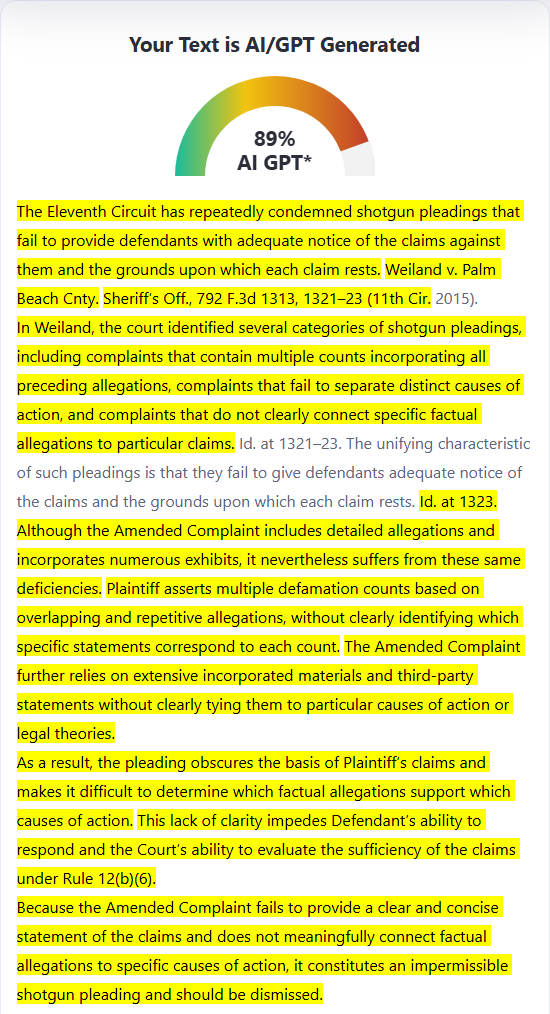

Granted, this is AI checking AI, so you have my permission to take that with a grain of salt. I also ran Karl’s text through, as a consistency check, and a small number of scattered bits come up highlighted as well. But those were limited to case law citations and quotes, which of course are going to be repeated through many of the documents these AI models train from. With Ms. Mitchell, it’s much of the actual bulk text drawing the yellow card. (Timely World Cup reference.)
At least now we have a good idea why so much of it didn’t make any sense lol.
I KNOW YOU’LL GET TO LIKE IT IF YOU GIVE IT A CHANCE NOW
Countering this motion to dismiss, Karl promptly filed an opposition brief, which you can read here:
As we saw before, Karl was denied electronic-filing access, so what we have is a scan of a printed document with slanty text. Karl eviscerates Michele’s motion in his intro:

From there, Karl jumps right into an actual honest-to-gosh legal standard for a motion to dismiss:

Uh-oh! Karl knows case law!

And yup, everything checks out. The appeal in “Ironworkers” relies on a previous case, “American Dental Association v. Cigna Corp”, which itself was quoting something called “Mills v. Foremost Ins. Co.” I’m not looking to backtrack through a hundred years of defamation law, but it seems that bit is settled. “Jackson” and “Bell Atlantic” easily affirm Karl’s citation, as does the syllabus in “Ashcroft”. The appeal in “SFM Holdings” goes a bit deeper, involving a dispute over whether a proposed complaint amendment can be taken into consideration. I’m not a lawyer, but I don’t see any reason this is misapplied. Granted, each of these rulings involved cases where the motion to dismiss was granted, but (setting aside my uncertainty over “SFM Holdings”) the opinions make the standards expected to overcome MtD quite clear.
In contrast to Michele’s total avoidance of specificity, Karl’s response is like a drink of fresh water:
The FAC identifies the publications at issue by speaker, date, platform, and quoted language. Count I identifies Mitchell’s June 24, 2025 X post and December 4, 2025 livestream statements. FAC ¶¶ 80, 81. Count II identifies Mitchell’s June 3, 2025 YouTube video, August l2, 2025 X post, and August 27, 2025 livestream statements. Id. ¶¶ 89-9l. Count III identifies Mitchell’s November 12, 2025 livestream statement concerning the 2021 GoFundMe. Id. ¶ 99. Count IV identifies Mitchell’s November 12, 2025 livestream statement concerning Notch. Id. ¶ 107. Count V identities Mitchell’s August 27, October 29, and December 4, 2025 livestream statements. Id. ¶¶ l15-ll7.
Federal Rule 8 governs pleading sufficiency, and a plaintiff in federal court need not satisfy Florida’s stricter state-court pleading requirements for publication. Caster v. Hennessey, 78l F.2d l569, 1570 (11th Cir. 1986). Here, Plaintiff pleads far more than Rule 8 requires.
You know you’re in shit when they drop Federal Rule 8 on you. Karl continues arguing, with full specificity, why each of the defamation counts properly allege Billy’s statements are false.
Karl certainly did not miss the fact that Michele undermined her own arguments:
The MTD asserts that these facts do not establish falsity, though at this stage it is not a requirement for them to do so. MTD at 8. Whether these facts give rise to a finding of falsity will be the duty of a jury to decide. The MTD even concedes that these facts are “subject to differing interpretations” and “reflect competing interpretations”. Id. at 8, 9. As such, they are, admittedly, plausibly capable of supporting a finding of falsity.
Spoiler: This will not be the last inadvertent admission from Mish we’ll see.
Karl asserts that he is “not a public figure for the purposes of defamation”, and thus should only have to demonstrate Billy’s negligence and not the higher malice standard. Following Karl’s and Billy’s public spat as we all have, this reads as the weakest part of the filing, but Karl still makes his case well enough. First, he correctly points out that the MtD does nothing to establish Karl as a public figure; it simply asserts it and moves on. Citing “Mile Marker, Inc. v. Petersen Publishing LLC”, Karl posits that for someone to be a limited sphere public figure, Florida law requires a “public controversy” with the plaintiff in a “sufficiently central role”. Thus, as Karl argues, Counts I and IV don’t qualify, as they deal with a personal bankruptcy and a private funding agreement with Notch. As for the other defamation counts, Karl cites “Hutchinson v. Proxmire” from 1979, which dealt with the question of whether the defamatory statements themselves created the public controversy.
To be clear, I don’t expect this argument to land in Karl’s favor, for a number of reasons. For one thing, the judge may not want to be seen as coming alllllll the way down on one side exclusively, and certainly nothing else we’re covering today stands out as worth ruling in Billy’s favor. Still, Karl is doing his job, not conceding that which he doesn’t have to. His arguments are cogent enough to be worth the court’s consideration.
At any rate, Karl also properly argues that if the court does require the higher malice standard, then each count still meets that bar anyway. Again, Karl discusses full specificity on each claim, and all the evidence buttressing them. (Heh heh, I said “buttress”.) We’ve covered these details here in the previous two updates, so I’ll skip rehashing it all today. Karl concludes this section by calling out Mitchell’s handwaving away of the trustee report:
Although logically incoherent, the MTD seems to rely upon a blanket, unspecified claim that the FAC does not plausibly allege actual malice. The only attachment to any facts pled in the FAC is a reference to the trustee’s report. MTD at 6. The MTD seeks to undermine the significance of the report by referring to the trustee simply as “a third party”. A bankruptcy trustee in Australia is a private insolvency practitioner appointed to administer a bankrupt estate under the Bankruptcy Act, exercising statutory powers and duties under Inspector-General oversight. It is the trustee’s statutory duty to investigate the debtor’s affairs and report to creditors and the Australian Government agency responsible for administering Australia’s personal insolvency system. The trustee is not merely any third party, it is the very authority that investigates and dictates if any offences by a bankrupt are committed. While Defendant appears to believe the findings of the trustee irrelevant, the Australian Government, and certainly a jury, may not.
The next section gets into defamation per se. Karl discusses the legal foundation, which I don’t think we need to cover again. Accusations of serious criminal conduct, you know the drill. Amusingly, Karl offers why written Florida law makes his own case for him (emphasis his):
The matter of whether each of the defamation counts accuse Plaintiff of criminal conduct is not in doubt. Each count alleges direct accusations of felonious crime on its face. For Count I, the statements that Jobst “engaged in serious illegal activity” and lied to the trustee “like somebody evading taxes” do not require interpretation. FAC ¶¶ 80, 81. Bankruptcy fraud and tax evasion are felonies, punishable by up to 5 years of imprisonment. See 18 U.S.C. § 152; see also 26 U.S.C. § 7201.
Counts II through V are concrete allegations of felony theft, and this is best illustrated by looking at the definition contained within Florida’s theft statute: “…obtaining money or property by false pretenses, fraud, or deception.” Fla. Stat. § 812.0l2(3)(d)1. For Count II, Mitchell’s accusation that Jobst crowdfunded with the “knowledge and intent” to do so under “false premises” to “gain $200,000 from his audience” may as well have been read from the theft statute itself. Id ¶ 89. With the amount of the fraud being such a substantial size, this would be classed as a first degree felony, punishable by up to 30 years imprisonment. See Fla. Stat. § 812.014(2)(a)1.
Karl continues going through the counts, highlighting Billy’s use of words identified in the statute. Billy says Karl “deceptively took” half a million dollars from his viewers. Look at that, the word “deception” is covered. The statute doesn’t refer to the word “scam”, but Karl argues this carries basically the same connotation. To that end, Karl cites a 2025 case titled “Paul v. Findeisen”. I plugged the names into Google only to discover “Oh, that’s Logan Paul versus Coffeezilla!” Karl then dunks on the lazy MtD with more of that dry Australian humour:
Defendant attempts to mischaracterize each statement at issue by reducing them down to a single word. MTD at 7. Indeed, in a vacuum the word ‘scam’ without any surrounding words or context may not be actionable. However, Plaintiff is not basing his claim on a single word. Each publication involves many words, with each extra word providing further meaning. Even simply adding a precise dollar amount will give rise to an actionable claim. For example, by Defendant saying “scammed $200,000” the audience is now told many things. The specific transaction (The 2022 GoFundMe), the victims (Jobst’s audience), and the mechanism (fraudulent fundraising) are all expressed by merely adding specificity to the statement. Therefore, it becomes subject to verification and is susceptible to being proven true or false.
This last bit flows into Karl’s argument that Billy’s statements are verifiable, and thus are not “pure opinion” or “rhetorical hyperbole”:

Karl also ties this into Billy’s contextual remarks. The “serious illegal activity” tweet was accompanied by a threat of new litigation. Billy’s stream remarks included “If that doesn’t piss you off, I can’t help you”, and “I think if I did that, I’d probably be in jail”, and “I’m telling you something that isn’t reported.” And of course, Karl remarks on the MtD’s lack of specificity in any of its sweeping denials, and the difficulty in responding without that specificity. As for “statements by third parties” (such as the Reddit post and stream viewer comments), Karl emphasizes that what is at issue is not those remarks themselves, but Billy’s “agreeance and adoption” of them, which “allows for more accurate inferences to Mitchell’s state of mind.”
A LITTLE BIT OF RHYTHM AND A LOT OF SOUL
The rest of Karl’s response deals with Counts VI and VII (likeness and IIED). Once again, the straightforward nature of the statute is clear (although Karl improperly clips the extended quote at the end):

Karl discusses the nature of discount codes and their use, and whether that qualifies as “a tool for commercial use”. No case law is cited, so I’m guessing this is an open legal question. Whatever the court decides here, this very case may be cited a bunch going forward (although Karl’s claim of unauthorized use of name and likeness goes well beyond just those codes). As for the MtD’s assertion that Billy’s remarks constitute general commentary, Michele’s lack of specificity sinks her again:
[The MtD] further states that “the Amended Complaint itself alleges that Defendant used Plaintiff’s likeness in the context of online videos, commentary, and related content critiquing Plaintiff’s conduct, financial dealings, and related public controversy.” Id. at 12. But the FAC alleges neither that Mitchell used Jobst’s likeness as part of expressive commentary, nor that Mitchell used Jobst’s likeness in the context of commentary and critique. The MTD fails to cite, point to, or explain which facts pled in the FAC give rise to these characterizations.
To put it another way, the problem isn’t Billy discussing Karl’s financial dealings and such. The problem is Billy using Karl’s name and likeness for the purpose of commerce and advertising. That’s what the FAC is alleging.
For the “Girls Gone Wild” case the MtD cited, Karl correctly points out the distinction between someone appearing in an “expressive work” and their name and likeness being “used in advertising the user’s goods or services, or [being] placed on merchandise marketed by the user”. And of course, Karl points out that Billy’s “own failed right of publicity claim against Cartoon Network” was dismissed “precisely because the character at issue was not Mitchell” (emphasis his).
For IIED, Karl relies on stuff like “Law of Torts” by Prosser and Keeton, and something called “Restatement (Second) of Torts”. This is where we really get into those dusty books on the court library shelf:

I’m not sure if the full “Restatement” volumes are available online, through official or unofficial channels. But Karl refers to passages by way of other cases which cite them. “Dependable Life Insurance Co. v. Harris” cites Law of Torts as arguing that “Successful actions have been prosecuted in this context based on outrageously high pressure tactics of collection agencies, other creditors, and insurance adjusters seeking to force an unfair settlement.” Note the specific reference to “other creditors”. This ruling also quotes “Restatement” as follows:
The extreme and outrageous character of the conduct may arise from an abuse by the actor of a position, or a relation with the other, which gives him actual or apparent authority over the other, or power to affect his interests. Thus an attempt to extort money by a threat of arrest may make the actor liable even where the arrest, or the threat alone, would not do so. In particular police officers, school authorities, landlords, and collecting creditors have been held liable for extreme abuse of their position.
Guys… I think Karl did his homework.
Karl once again goes over many of the facts we’ve discussed in previous updates. But then Karl refers to a “Comment ‘f'” on section 46 of “Restatement”, as provided in the Insurance ruling:
The extreme and outrageous character of the conduct may arise from the actor’s knowledge that the other is peculiarly susceptible to emotional distress, by reason of some physical or mental condition or peculiarity. The conduct may become heartless, flagrant, and outrageous when the actor proceeds in the face of such knowledge, where it would not be so if he did not know.
And this, Karl argues, relates not only to Billy’s campaign of deliberate humiliation against him, but also to Billy’s endorsement of viewer comments to the effect that Karl’s voice is shaking, that Karl is “on the ropes badly”, along with Billy’s stated intention to escalate the causal conduct. I’m sure some will consider all of this general Internet beef, especially in the aftermath of the widely publicized lawsuit in Australia. My initial reaction to this new lawsuit was that the defamation was the real meat, and that Counts VI and VII may have been tacked on as an additional free roll. (Again, I speak only for myself and not for Karl.) But ultimately, the problem here isn’t what the court of public opinion feels about Billy’s particular conduct – it’s whether the court of law will agree.
Karl wraps this section up by addressing the MtD’s characterization that the IIED count is merely defamation dressed up differently:
The MTD attempts to simplify this claim down to something it never purported to be. Defendant states that the claim of IIED is duplicative of the defamation claim: “[I]t is based on the same alleged statements and publications that form the basis of his defamation counts. The Complaint does not identify any independent conduct that would support a separate emotional distress claim.” MTD at 15. Clearly, as outlined above, this is not the case.
In summation, Mitchell’s behavior is not a defamation cause of action redressed as a claim for IIED, nor is it simply a fiery disagreement between two online parties. The FAC alleges that Mitchell is a dominant creditor abusing his position of power with the admitted goal of “busting” Jobst’s career, reputation, and health to pieces. Therefore, the FAC adequately pleads a claim for IIED.
Karl also briefly shoots down the assertion that the FAC is a “shotgun pleading”, which was asinine to begin with:
The MTD alleges that the FAC is a shotgun pleading. It relies on two propositions. The first is that the FAC “asserts multiple defamation counts based on overlapping and repetitive allegations, without clearly identifying which specific statements correspond to each count.” MTD at 16. Plaintiff is confused by this as each count in the FAC clearly identifies the exact publications and statements they rely upon, as outlined above in the ‘publication’ portion of the defamation counts argument.
But my personal favorite detail in the entire document comes at the very end:

Did you catch that?
No, not the signature.
The date.
Michele’s motion to dismiss was signed on June 9th, filed the same day electronically. The court timestamp for Karl’s motion is June 12th, because he has to do whatever roundabout thing he does without electronic filing.
But it was signed on the 11th.
Two days after receipt of the Mitchell motion.

Karl didn’t fucking research and write all this shit in under two days. I’m telling you, strictly by my personal belief, Karl had most of this ready to go. He knew Mitchell would file a motion to dismiss of some sort, and he didn’t wait for it to happen. He was read up on “Restatement of Torts”, and Prosser and Keeton, and all of that. Karl had all the legal basis loaded in the chamber, ready to fire this whole time, with some extra space to tailor toward the actual MtD as written. I won’t claim to know what kind of reply window Karl had to operate in, but I can guarantee it was more than two days. Filing this quickly was a choice. It makes a statement. It also puts Michele in a tight spot. She may have been thinking “Okay, Karl will respond in seven days [or whatever], I don’t have to worry about it until then,” and then suddenly the ball’s immediately back in her court, with a massive pile of legal citations she obviously hadn’t prepared herself for.
I wonder if Mish is still giggling in that office chair.
MORE SECURITY
This has already been a heaping helping of legal fodder for one day.
But we’re not done yet.
You see, I promised you a real loco-motion.
And to quote Billy Mitchell, “You ain’t seen nothing yet.”

The motion to dismiss was bad, perhaps even uniquely awful. But it was merely a peek, a glimpse beyond the periphery of madness. T’was but a taste of the mind-unraveling brew insanity’s cauldron has in store for us today.
Folks, I present to you… Michele T. Mitchell’s motion for security costs:
We’re not going to don the stupidity goggles this time, because they wouldn’t work here anyway. If you just read the motion itself, and know nothing about the background, it can read as a more-or-less valid request:

That makes sense, right? If you’ve followed the whole Billy Mitchell saga for years, then you’re familiar with Twin Galaxies’ request for “Undertaking”, which was granted in October 2020. This forced Billy to put about $80,000 in a security deposit – an exorbitantly large amount, from what I’ve heard – so that TG could recover legal costs in the event they prevail. This new motion for security costs is basically the same idea. To paraphrase, “We think we’ll win, and we think Karl can’t pay, so we want him to put up a bond first so he can’t get out of required reimbursement.” Mish even asks for more-or-less the same amount granted in the TG case: $80,000.
To that end, Michele emphasizes Karl’s allegedly precarious fiscal situation:
Plaintiff further admits that he cannot consistently afford routine litigation expenses, including the cost of expedited international mailing, and must carefully ration such expenditures.
Plaintiff’s foreign residency, admitted financial hardship, and inability to bear routine litigation expenses collectively demonstrate a substantial risk that Defendant will be unable to recover taxable costs at the conclusion of this action absent the posting of security.
“Taxable costs” refers to when the court orders a losing party to pay some portion of the prevailing party’s legal fees. Right away, one might ask how likely it would be for Billy to be awarded “taxable costs”. In Commonwealth law, it’s more-or-less expected (or at least, so it is my understanding) that the loser has to pay the winner’s legal fees, but here in ‘Murica, that’s not standard by any stretch. Often, you win a lawsuit defense, and just have to eat shit on your lawyer bill.
In her “Legal Standard” section, Michele posits that “Federal courts possess inherent authority to require a plaintiff to post security for costs”. And she cites three cases, which we’ll discuss later. Mish emphasizes the factors courts can consider, when exercising this supposed authority:

Huh, glad “plaintiff’s ability to pay” got slipped into that parenthetical. Still, the motion seems to spin Karl’s relative destitution as a basis for granting their request for a security deposit:
Accordingly, the inquiry is not whether Plaintiff has limited financial resources, but whether the circumstances presented create a substantial risk that a prevailing defendant will be unable to recover taxable costs.
On the surface, this could make sense, right? “Oh, he can’t pay, and it’s not fair to us if he sues us and then can’t pay if he loses, so the court should make him put his money where his mouth is before we go to all the trouble.” Mish also reminds the court that Karl is Australian, and that international debt collection would be burdensome.
Aaaaand… That’s pretty much it. The same basic rhetoric, repeated over and over, for eighteen pages. “This litigation will be expensive, and Karl doesn’t have money, so it will be hard to collect, because he’s Australian, and he doesn’t have money, also he’s Australian, and so collection for our expensive litigation will be difficult against the Australian in Australia who doesn’t have money, and is hard to collect from.” Mish is really stretching for that English Lit page count this time. Sometimes the filing repeats itself in back-to-back sentences:

Did Mish even proofread this herself? Like at all? That’s the kind of stuff you catch immediately. I don’t see any glaring typos, aside from misuse of ellipses (not that I would know anything about that lol). For the record, I did run this motion through the same AI-checker tool, and it does score surprisingly low this time. At least the fact the tool will report 0% AI on multiple sections confirms those earlier high scores weren’t artificially inflated. Even so, just taking a casual reading, this motion comes across as way more auto-generated than the first.
Michele also seems to contradict herself a bit:

So plaintiff is broke and can’t pay for the proceedings, but “requiring a bond does not bar” him from pursuing his claims? Which one is it? What are you even doing?
Mish included three exhibits. Two of them were to demonstrate that Karl relied on Carlos Pineiro to deliver the complaint and pay the filing fee, once again in an apparent attempt to emphasize Karl’s insolvency. The third exhibit was Judge Ken Barlow’s Brisbane ruling, at 118 pages. It is not the job of this Florida court to relitigate that proceeding, and Michele does acknowledge that. Aside from their obvious hope that this new judge reads Barlow’s negative personal assessment of Karl, it seems the point was (as you saw a moment ago) to emphasize the “unusually personal and adversarial nature of the parties’ dispute”. Of course, this already seems like a double-edged sword. The fact that Billy and Karl hate each other works against Billy as well. And Billy’s the defendant this time. It’s certainly not an excuse for deliberate slander, or unauthorized use of name and likeness. Plus, assuming this judge bothers to read any of the Barlow ruling beyond the limited bits Michele cited, there’s always the chance he or she is a bit more astute, and sees through Billy’s obvious lies Barlow ran cover for. “Oh, that’s strange. Mitchell said in the U.S. the Jobst case had minimal stress, then turned around and said the exact opposite in Australia? Why would this judge think this is okay?” It’s not like judges are internationally monolithic and don’t see each others’ stuff overturned on appeals routinely.
EASIER THAN LEARNING YOUR A-B-C’S
Okay, Michele’s not great at arguing her own case. But still, that doesn’t mean the basic premise behind the request is wrong, does it? She can certainly ask the court to require Karl to put up a bond…
…right?

Yeah, so about that…
THERE’S NO FUCKING LAW GRANTING SECURITY DEPOSIT REQUESTS IN FLORIDA!!!
The MSC does not sufficiently provide the legal basis for its request. There is no Federal Rule that governs a Motion for Security for Costs. In circumstances where a demand lacks foundation in the FRCP, the court is required to undertake an “unguided Erie” inquiry to decide whether to apply state law or federal common law. Carbone v. Cable News Network, Inc., 9l0 F.3d 1345, 1349 (11th Cir. 2018). Undergoing such an inquiry, the Court will find that no applicable state law or federal common law exists to support such a motion in the Southern District of Florida.
Props to anyone who had “Unguided Erie Inquiry” on their bingo boards today. There’s apparently a whole-ass procedure Michele should have undertaken in her motion, but didn’t. I’m not going to try to understand it here, at 3:30 in the morning. The point is, the relevant law does not exist. A federal law on this doesn’t exist. Instead, federal courts rely on local laws in the given jurisdiction. And there is no local law to support this motion either.
Aside from her invocation of the Barlow ruling, Michele cited three “supporting” cases in her entire brief: A Nevada case called “Simulnet East Associates v. Ramada Hotel Operating Company”, an Oregon case called “Clopper v. Merrill Lynch”, and a Puerto Rico case called “Aggarwal v. Ponce School of Medicine”.
Before we take a single step further, I want you to lodge a guess as to what happened in two of those cases. Write it down, open up a Notepad, mental note, whatever. Just make a guess.
What do you think happened in the cases cited by the attorney spawn of Billy Mitchell, as she argues for a deposit requirement?
Well, let’s see…
The Merrill Lynch ruling granting security costs was upheld on appeal in 1987. So the attorney was indeed required to pay costs. Amusingly, this ruling was based on Oregon statute 20.160, which Karl discovered was repealed in 2009. So that same scenario in that same location today would not land in favor of a request for security costs. I’m not sure I ever would have caught that detail myself. Hey, looks like Karl’s doing some S-tier research on these citations!
So… How about the other two?
You may be shocked to learn that the security requirement in Simulnet was overturned on appeal lmaoooooo!
And why? Oh, because the court should have known the bond functionally amounted to a dispositive ruling:
The court knew that the plaintiffs could not post the bond, but imposed the bond because of its belief that the defendants would prevail in the jury trial, even though the court declined to hold the plaintiffs’ claims were vexatious. In practical effect, this amounted to a judgment as a matter of law in a case where discovery proceedings revealed there was a genuine issue of material fact to be determined by the jury.
Once again, did Mish bother reading her own citations?
Oh and you’ll never guess what happened in Aggarwal! The request there was pursuant to a “Rule 5” in local Puerto Rico law. But once again, the appellate court vacated the bond ruling because, in part, “no evaluation was made of Dr. Aggarwal’s ability to post bond”:
While it is neither unjust nor unreasonable to expect a suitor “to put his money where his mouth is,” […], toll-booths cannot be placed across the courthouse doors in a haphazard fashion.
Two of the three “supporting” case law citations in the entire document actually work against Michele’s request. What is going on!? What are you doing, Mish? Damn, she’s lucky her AI bothered to cite real cases in the first place.
And again, even if you set aside the reason these cases were overturned, they were based on local laws (yes, even in federal courts), and there is no Florida law allowing this. And Michele cited nothing to demonstrate that it’s a non-statutory court practice in the state. This is like filing an anti-SLAPP motion in a state with no anti-SLAPP law! The concept only exists because certain laws in certain jurisdictions identify the concept and explicitly allow it. You may as well ask the court for a magic goat pony unicorn which mows the lawn and writes competent motions to dismiss for you. “Oh please guvnah, ’tis in your discretion to give me this magic goat pony, and t’would make me very ‘appy, t’would!”
Isn’t Michele an attorney? In Florida? How does she not know this? How does she not put together her own filing and go “Wait a moment, this is awfully lean on legal standard”? Is she just fucking with the court?
Oh, but the lunacy continues! As Karl discovered, Florida used to have a statute requiring nonresidents to post a court bond, but it was repealed in 2016. And Michele’s request was… Well, let’s just say it was a bit out of scale lolololololol:

This motion is already dead.
Stone fucking dead.
Can you believe it’s about to get deader?
THERE’S NEVER BEEN A DANCE THAT’S SO EASY TO DO
In addition to pointing out the numerous flaws with Michele’s argument, and the ways in which Aggarwal undermines her own case, Karl also breaks out a couple citations of his own. He cites one additional case, “Psychiatric Associates v. Siegel”, heard by the Supreme Court of Florida, to the point that “The constitutional right of access to the courts sharply restricts the imposition of financial barriers to asserting claims or defenses in court.” And Karl also points to the Constitution of the State of Florida itself, which briefly emphasizes the importance of “Access to courts” for everyone.
The law doesn’t allow for a security bond. The state Constitution is anti-bond. The state Supreme Court is anti-bond. Literally every authority here is anti-bond.

As for Aggarwal, Karl employs this galaxy-brained strat of actually reading the material, and points out the court emphasized the need to consider three key factors:
In fine, D.P.R.L.R. 5 demands that the court construct an equation composed of at least three integers: (i) the degree of probability/improbability of success on the merits, and the background and purpose of the suit; (ii) the reasonable extent of the security to be posted, if any, viewed from the defendant’s perspective; and (iii) the reasonable extent of the security to be posted, if any, viewed from the nondomiciliary plaintiff’s perspective.
The first one’s pretty easy. You need to show that your case has a likelihood of succeeding. That’s what Twin Galaxies did in its request for undertaking in the California case. It spent pages laying out the “reasonable possibility” that the contested statements about Billy’s DK scores were true, and that “Billy Mitchell cannot show Twin Galaxies acted with actual malice”. It discussed Carlos’ attempts to investigate Billy’s scores. It cited David Race’s account, which the filing called “especially persuasive” because Billy also relied on David’s testimony. And it highlighted the efforts TG went to to verify Jeremy Young’s score dispute claim. It turns out you have to do this if you’re asking for a security bond. Or at least, the Aggarwal court seems to agree.
For the second one, as the moving party, you have to show why your request is reasonable relative to what your needs will be. You can’t just pluck shit out of thin air.
In his opposition, Karl did not cite “WILLIAM JAMES MITCHELL VS TWIN GALEXIES, LLC” from California. (And yes, amusingly, if you search for case #19STCV12592 on the LA Superior Court website, that is exactly what the case was called. Someone, I can’t say for sure who, misspelled “Galaxies” on Billy’s original cover sheet lmao.) But we can once again find that case instructive. The Mighty Mister Tash didn’t just say “Hey, we should win, so Billy should have to put up a bunch of cash.” He included a declaration spelling out all their expected costs:

In case folks are curious, I’ve never been given a definitive full accounting of all depositions from the TG case. Pretty sure Todd Rogers and Morningdove Mahoney were never directly questioned, and I know Junior was not, because Billy’s side found a way to wrap him into the law firm and insulate him from discovery. So not all of these anticipated costs materialized, but they don’t need to be. It was a reasonable estimate. More importantly, Tash outlined to the very dollar why those anticipated costs equaled their undertaking request of $81,225 (although the filing mistypes the total as “$81,2250.00”). So if Team Billy did try to copy-and-paste the TG request from California, they didn’t do it very well.
(I’m not just drudging up all this trivia on the TG case to show how funny it is that Mish thought her one reference to “Mitchell v. Cartoon Network” was cutting video game lore. Although it is possible that is also a good reason.)
And lastly, for the third prong, you have to show the reasonability of the request as “viewed from the nondomiciliary plaintiff’s perspective”. (I had to look up “nondomiciliary”, but it basically means “foreign” or “out-of-state”.) In other words, does this take the plaintiff’s monetary situation into proper consideration as well? Obviously, this works in Karl’s favor, as he outlines with his own added emphasis:
Plaintiff’s financial position is undisputed. Defendant argues that Plaintiff cannot afford to proceed with the litigation absent a bond. MSC at 9. It is impossible to square this argument with the notion that a bond would not irrevocably deny Plaintiff’s access to the court. The core principle that guided Aggarwal was the idea that the imposition of a bond should not occur without considering the plaintiff’s ability to pay[.] It should be difficult to conclude a bond requirement would not cause a direct conflict with this philosophy, even if the request had a statutory basis.
Let’s set aside the fact that this whole motion was doomed from the start. If Michele had actually read and understood her own citations, she would be arguing the opposite, wouldn’t she? It would be “Mr. Jobst is a foreign plaintiff, it will be hard to collect costs, and also we dispute his claims of destitution and believe a reasonable bond will not be prohibitive.” She would be emphasizing Karl’s reliable YouTube and sponsorship income, or the fact he’s apparently been able to source funding from his wife on occasion, including in Karl’s post-judgment settlement offer. Michele wouldn’t be surrendering this key point, and doing Karl’s work for him.
And that’s not the only self-defeating admission from Michele in her born-to-fail-anyway joke of a request. See if you catch this, as Karl points out:
At this stage, the only witness Plaintiff intends to depose is the Defendant. The First Amended Complaint (ECF No.8) (“FAC”) points to a vast landscape of contemporaneous documentary evidence, and not once does it rely upon evidence that would require further third-party testimony. Defendant’s Motion to Dismiss (ECF No.16) (“MTD”) even admits that “the statements identified in the Amended Complaint arise from publicly known events.” MTD at 7. Having characterized the case as turning on publicly known events, Defendant cannot now attempt to justify an $80,000 bond by invoking vague unidentified discovery burdens.
Hmmm, I guess we can already rule out a surprise bombshell like “Oh no, I was talking about OTHER serious illegal activity during the bankruptcy process.”
This is why, when you have a case as utterly fucked as Billy’s was from the start, you need a defamation specialist on defense. Instead, Michele’s haphazardly riding her bike through a china shop like “Oh, don’t worry! I know how to ride a bike, I’ll be fine!”
Karl concludes his security opposition with a look at Billy’s and Michele’s post-filing conduct:

Karl also included an exhibits page, showing off some of Michele’s tweets we saw earlier:
But the spicy new bit came by way of some “attorney” correspondence between Karl and Michele directly:

Lawyers are always calling each other “Colleague”, and Karl seems to be playing the part as well. It may be technically improper, as he and Michele are not “colleagues”, but I’m not sure what a pro se is supposed to say here. “Dear Attorney”? “Dear Counsel”? “Ms. Mitchell”?
At any rate, Karl explains why this simple denial is a demonstration of bad faith on the opposition’s part.
Further, Defendant opposed a reasonable request for extension of time to file this opposition. Id. ¶ 9, Exh. F. Naturally, it is the right of a party to oppose a request for an extension. However, Defendant pleads to the court to impose a bond, in part, due to Plaintiff’s logistical concerns, while simultaneously refusing to entertain a reasonable request. Plaintiff is of the belief that Defendant’s decision to file two concurrent motions while counsel ‘giggles’, without allowing any leeway given Plaintiff’s pro se and foreign status, is illustrative of the bad faith nature of Defendant’s strategy.
Whereas Michele stuffed 17 pages with repetitive filler (twice!), Karl wrapped up his utter demolishing of the request in under seven pages. I guess when your case is this strong, you don’t have to bother using the rest of your allotted time.
But there’s yet another subtle detail to this, which I love. Now, I have to re-emphasize, I do not speak for Karl Jobst. I’m not a mind-reader. This is 100% purely my own personal speculation. But I can’t help but ponder how Karl asked for an extension of fourteen days, was denied, and then had his opposition filed less than a week anyway. Did he really need that extension? Would he have fleshed out this opposition a bit more had he been granted more time? Maybe. It’s entirely possible Karl’s deadline was about a week, and Karl put together what he could in that window and sent it off a bit early to make sure his delayed third-party submission chain didn’t run afoul of the deadline. And he was correct to point out that these motions were filed at the same time, thus forcing him to work on both concurrently (even if his MtD work may have had a head start). But – again, speaking strictly for myself – there’s a part of me that enjoys the thought that Karl asked Michele for that extension just to see if she was dumb enough to deny it. And it turns out, she was, and that denial made it right into the filing. And I wouldn’t consider this a grand maneuver if it was just about torpedoing this particular motion, which was already sunk. But it was included for the purposes of establishing a pattern of bad faith engagement by the defense. And I hope things like that will linger with the judge.
Karl Jobst is playing chess. Michele T. Mitchell is letting ChatGPT play her checkers.
IT EVEN MAKES YOU HAPPY WHEN YOU’RE FEELING BLUE
Even though I could see the merits of this case right away, I was wary about getting too braggadocious out of the gate. You just never know how things will play out. And sometimes the law doesn’t work in practice the way you think it would. As I said in the intro, I feel like it’d be a bit too Dunning-Kruger of me, a non-attorney, to think I can read a legal complaint and know for sure its viability, especially when I have yet to hear from the opposition. And as I conceded, Michele’s motion for security costs can read as reasonable, until you realize she offers no supporting legal standard, there’s no law supporting her request, and all her citations work against her to such an extent that one must question whether she bothered reading any of her sources.
However, I am competent enough at law journalism to read competing filings and suss out who has a serious case, and who’s blowing smoke. And now that we have heard from the Mitchell side? I have zero worries about this outcome. They had their shot, and they shot a blank. The trial is a long way away, and juries are always a major source of RNG, but if this were strictly about the merits of the arguments, Karl should prevail over this motion to dismiss and the motion for security costs on every single count across the board (with the possible exception of any “limited public figure” arguments). But again, you never know what kind of judge you’ll get. So I guess we’ll wait and see.
There was a brief Twitter interaction between Mish and one of her friends, which I thought was interesting:

This reads like such a before-and-after, does it not? Have you ever had to tell your parents they have to do something? Or not do something? It often doesn’t end well. Now imagine your father is Literally Billy Mitchell. And you have to tell him to shut up, or to take down all his existing Karl posts and discount codes. And maybe he doesn’t want to, because that would be showing weakness, and he wants the attention and enjoys the gloating. But of course, we can see Michele’s not even trying – she’s yukking it up right along with him! Billy may have a loyal attorney, one who will represent him to the bitter end, but he doesn’t have an attorney he sees as an adult equal who can put him in his place. Mish may be unwaveringly loyal now, but I can see a possible future where she has to ponder whether Aunt Karen was right about her father all along.
Anyway, it’ll be interesting to see how this all plays out. Thank you all for reading. Take care…
BUT WAIT!!!

THERE’S MORE!!!!
Holy smokes!!! As I was wrapping this up, the newest most insane thing of all time ever for reals this time just dropped:

Michele’s firm has withdrawn… leaving Michele to represent her father personally, as an independent attorney.
Karl makes a “Bad Faith” argument against Billy’s lawyer, and the firm is like “Nope, we are outta here.”
Meanwhile… MICHELE T. MITCHELL HAS BEEN SCRUBBED FROM THE FIRM SITE ENTIRELY OMGGGGGGGGGGGGGG!!!!

https://jambg.com/lawyer-profiles/michele-t-mitchell
Was she fired? Was it a voluntary separation? “Fuck you, I quit”? Your guess is as good as mine. Based on the evidence laid out today, I’m going to assume it was a termination. I can’t imagine the timing, not 24 hours after her tweets getting featured in a federal filing, is a coincidence. Maybe publicly hamming it up about her case, with her client, was a deal-breaker. Maybe they didn’t know about her Twitter activity at all. Maybe they already kinda knew she was bad at her job, and this was the final straw. Maybe they ran her filings through the same AI checker I did. Maybe it was a combination of everything. “You’re just too dumb to work for us.” That part we’ll never know for sure. But I’m guessing they didn’t let her have one last giggle in the office for old time’s sake.
Donkey Kong cheater runs his mouth, gets sued, relies on his daughter as his attorney, and gets his daughter fired!! Now THAT’S some epic video game lore!!!
If you thought the Mitchell family hated Karl before, their rage must be cataclysmic now. But I suspect there won’t be an ounce of introspection among them. It won’t be “Shit, we shouldn’t have involved our daughter” or “Fuck, I should’ve been smarter about my social media.” They won’t realize what a self-destructive idea it was for Michele to take on a personally-charged case outside her area of expertise, as if saving the money was more important. It’ll be “Karl fucking did this, he went after our family, this is all Karl’s fault.” Whether Billy Mitchell realizes it or not, he threw his daughter under the bus, like he ultimately does with everyone. He should have realized right away, “I screwed up, this case is deep doo-doo, I should settle immediately, I don’t want to read an apology to Karl, but I already stepped in it, so I need to cut my losses.” Billy Mitchell thinks he can get out of consequences through sheer determination, and he will drag everyone down with him in the attempt. He still hasn’t figured out how much better off his life would be today if he had just admitted to lying about his Donkey Kong high scores in the first place.
While things are going very poorly for Billy Mitchell, for Karl, this is the literal best case scenario. There is no universe with a better scenario than what we’re seeing right now, at least pertaining to this lawsuit. I was concerned a judge may be biased against a pro se plaintiff versus an established firm, but now it’s pro se versus an independent attorney who just got axed – which by the way, also means that Mish loses access to the law database resources of her firm. No doubt she’s going to keep making poor admissions and failing to really read the cases she’s citing.
Oh, and all you seething Karl haters who want to see him taken down a second time, you better start buying lots of hot sauce! Just chug that shit down, feed it to your dog, water your plants with it, put it in your soap dispensers, give it to everyone you know. Your boy Billy’s gonna need that cash. Maybe he should package his sauce with some extra toilet paper for you, with a new discount code “RIP MISH”.
We’ll see you all here next time, hopefully with even more good news.
Karl’s chances of winning will see a 69% increase if Silly and Micheal keep jeopardizing their case lmao. One factor to Karl’s Brisbane loss was him talking about the lawsuit too much for GBF to twist his comments out of context. Billy is repeating every mistake Karl made plus continuing the discount codes he’s being sued over. I was surprised it only took 2 months for Billy’s tweets to used against him.
I was thinking the same thing. It’s like the script is flipped. You see this in sports all the time.
You know what, the more time passes from April 9th (or whatever the lawsuit day was), the more I feel like this time Karl has much larger chances. That whole previous clusterfuck was a massive L for him, but he’s learned from it and doesn’t run his mouth now without need. He’s still mocked by some dumbasses, but that’s par for the course. His opponent, though, does keep silly-bitchin’ as usual. Here now hoping this judge has more than the one braincell the previous one shared with a stray orange cat.
Wait, I forgot my PFP in… is it Disqus? I don’t remember setting it anywhere else… is an orange cat. Did I just accidentally diss myself? Just proves my words about one braincell lol
lol I won’t say anything.
I honestly hate how Karl start this lawsuit, there are better ways to rebuild his reputation if that’s his actual intention ?.
I also understand billy initial celebration victory, because billy also in a way clear his name as not the guy drive someone into suicide. as For Donkey Kong, He still a cheat.
but this recent lawsuit saga turn into sort of revenge.. of the karl’s years long of videos guess…. I have no idea, now both of them could turn into lolcows i guess the internet term
If things go well for Karl, this the golden opportunity for karma to hit Billy in the form of his favorite weapon, creating a circle of fate and delivering a true legit win against him. As a matter of fact, it is already happening, since being dropped by two law firms and costing her daughter one job is already bad enough
Honest question: why do many people call Karl a lolcow? If that’s just because he tends to be a bit of an ass sometimes and has some difficulties admitting his failures, that threshold would make like 80% of Internet personalities lolcows haha
I mean, what is good for the goose is good for the gander.
By all accounts, Karl had his life financially ruined by Billy. But why did Billy go after him?
At the end of the day, Billy targeted Karl for the same reason he targeted Apollo. Karl was talking about Billy’s cheating. The fact that he found a way to sue Karl successfully shouldn’t distract from the reality that his motive was to shut Karl up, because that is what Billy does. He sues people. He sued CN, he sued Apollo, he sued Race and TG and Karl.
Karl won because he found an instance where Karl screwed up. Well Billy has screwed up.
I have zero pity for Billy. He is a litigious, life ruining thug who is for once on the wrong end of a legal system he has weaponize for his entire adult life.
Speaking of the Australian lawsuit, if Karl indeedly could have won, how had he stated that his appeal was turned down by the second lawyer he hired?
An appeal is not a redo or reassessment of the trial. It’s about identifying whether proper legal principles were upheld. Whether I like it or not, Barlow was empowered to weigh witness credibility. An appeals judge isn’t really supposed to say “No no, that guy wasn’t as credible as the trial judge thought he was.”
I can’t really help that Barlow fully bought in on Billy’s obvious, provable lies.
I also don’t have to agree with Karl. He and I are separate people.
Once again, it seems Cats fancies himself as a far superior legal expert much smarter than both the lawyers and the judges. How is it that he is not in front of the judge schooling him on everything about this case?
Once again, every single person criticizing Jobst adheres to the ad hominem logical fallacy. You ignore the argument in favor of the person making it.
“hOw dO yOu tHiNk yOu kNoW mOrE tHaN tHe LaWyEr?”
It’s one thing to say that when I criticize halfway competent motions – which I am allowed to do when I have good reason. But if you’re going to trot that out in defense of Michele Mitchell’s lazy self-contradictory self-defeating slop, then there’s really no filter to what will come out of your mouth.
Hats off to “Ersatz” for creating this in such detail and likely in such a timely manner…a L O T of work went into this and it made for both an excellent and informative read. Thanks !!
Thank you for reading as always, sir!
Oh totally agree Robert. Thanks Ersatz for the amazing detail. I’ll be digesting this over the next day or two.
As a writer I like how this one was written: serious legal stuff and attitude first and then end with an epic punchline. Tearing down daughter with arguments, and then hit her with the AI stuff. Giving the bond stuff some validation and then tearing it down, and then revealing the axing she got.
I thought that because of both sides have no money, this would not go anywhere. But it seems like this won’t be just sad, this will get ugly too. There is no “competitive gaming” or “journalism” angle here. Just two stubborn adults forcing each other through hell.
Mish hasn’t updated her LinkedIn or the Florida Bar about her evident lack of employment now.
Kind of sad really that GBF is pulling his family down with him, but if she went through law school and has been practicing for two years, you’d expect her to do a bit of a better job than Karl. Maybe she thinks that because he’s a pro se foreigner she doesn’t have to do her best?
Regardless, I think this will end very poorly for her. I think it was in your writings that I read that part of the role of a lawyer is to have someone who isn’t emotionally invested in your case to tell you whether or not you actually have one, and she pretty clearly can’t do that here. Daddy won’t listen to her because all he’s gonna see (aside from being a huge narcissistic twat, anyway) is the little girl he remembers.
If she doesn’t pull the rip cord now, I think she could potentially be putting her career at risk, especially if she keeps making filings in which she so obviously doesn’t do the work.
Thanks for the write up, EC, keeping up to date is a lot easier with your posts!
Eh, a young woman no longer working for a specific lawfirm isn’t likely to be connected to any specific lawsuit. The chances that they dropped her over this are so low they’re down near dinosaur bones.
And even then, losing one case like this wouldn’t meaningfully damage her career. This looks bad to most people, but no law firm is digging into the weeds on every filing you’ve ever made.
Michele’s employment status is the point where this is looking sad and ugly and winnerless enough that I start to feel slightly bad, but also, we are absolutely still in the realm of “play stupid games, win stupid prizes”.
First off, love the Suplex Train reference from FFV. Secondly, I hope they go to trial, because I’ll definitely be there this time. Its one thing to go to Australia (if not for COVID I had plans to attend the FIFA Women’s World Cup), but another thing entirely to just fly out to Florida. Once again, another fine write up.
Meant to say FFVI, damn autocorrect. Pixel remasters are endless replay value (I became a huge FF Fan thanks to Kingdom Hearts, BTW, very excited for KH4). If all goes according to plan, and he wins, I will personally treat Karl to dinner at Rickey’s (that invitation goes to you as well).
lol I wasn’t gonna say anything. I knew you meant VI. FF6 is my favorite game of all time, so it brings me joy to have a reason to call in the train suplex. Sabin even looks kinda like a beefed up Karl.
If it goes to trial – and it may – I will see you there in Florida. 🙂
“She says “No reasonable viewer could interpret [the Karl-as-a-lobster imagery] as asserting a verifiable statement of fact.” Yeah, no shit! That’s why Karl never made such an argument. He never claimed the lobster prints were defamation. That’s why it was never referenced in any of the five counts of defamation. Why are you making this insane argument to no one?”
She is hoping the judge takes her at her word and doesnt do any due diligence to read the case and handwaives it from the outset as a petty squabble over a lobster picture so that she gets an easy dismissal. She’s hoping the judge does as little work as she wants to, as an easy “solution” to her problem.
And sadly, based on the Australian lawsuit, that might work.
“Still though, you’ve gotta appreciate that doe-eyed optimism. “Oh boy! My boss is gonna let me handle this one by myself!”
Surely it violates some basic conflict of interest or ethical code to gift lead counsel solely to a family member of the defendant? And a competent lawyer would realize it as such and would decline the opportunity even if it did present itself out of incompetent decision making from the prior Lead attorney.
frankly i’m shocked its even allowed, it seems to open the door to appeals on its own, although I suppose because this is a civil case maybe thats not a concern for Karl and given how she’s doing so far, he’s willing to allow it.
Hoping for another Judge Wendy Chang?
You’re right, there is every chance it could happen.
Your post echoes of your posts on the last lawsuit, when you successfully convinced yourself Karl would win.
Karl will win this too. I noticed you never cover any of the news about the case that is going in Billy’s favour.
I don’t think you can be helped at this point, but please consider the fact that your hatred of Billy is so strong that you actually think a racist who referred to black people as animals is the good guy.
Billy* will win this too.
“Karl will win this…. I MEAN BILLY, Billy will win this.”
lol Thanks for giving me a chuckle to start my morning.
I do have to own that I believed Karl would win in Australia, and I was wrong. And I am trying to be a bit measured with this one for that reason – hence I’m saying the legal arguments presented support Karl, and not “Karl for sure will win”. But exactly what “news about the case that is going in Billy’s favour” am I not covering?
Be specific.
And don’t tell me you’re just thinking “Well, Billy seems pretty confident on Twitter, and he makes it sound like he’s winning a lot of things, so the case must be going his way.”
You can see everything available about the case right here:
https://www.courtlistener.com/docket/73162164/jobst-v-mitchell/
Also, I would like a source on your last claim. A lot of people make up wild things about Karl. I can only engage with material facts on that stuff.
The only things I know to have gone in favour of Billy here are the few procedural denials Karl received. The first one you did address and reveal it to be a nothingburger it was, the last two happened after your last major update post and were similar nothingburgers which Karl then resubmitted properly.
(As I’ve said before, I’m still a bit worried because that’s emblematic of Karl’s impulsiveness when dealing with this situation. He’s certainly doing much better now than during the first lawsuit, and thankfully none of Karl’s mistakes had grave consequences here yet.)
Regarding racism, I have no idea either. I think it might have been the case of broken telephone, such as when Karl joking about getting breast implants got turned by his haters into him forcing his wife to get implants. Maybe someone else, such as Goose, said some wild things (that does sound more plausible) and Karl didn’t react in a manner haters deemed appropriate. Or maybe someone just plainly made that up… Probably not, everyone on the Internet only speaks the ultimate truth, right?